Part of the Answer Engine Optimization Hub
AEO, GEO and SEO optimise for three different moments. SEO gets your page ranked in the list of links. AEO gets your content quoted as the answer above that list. GEO shapes how generative AI models describe your brand across all the answers they give. They overlap heavily, and some people use AEO and GEO interchangeably, but separating them makes your strategy clearer.
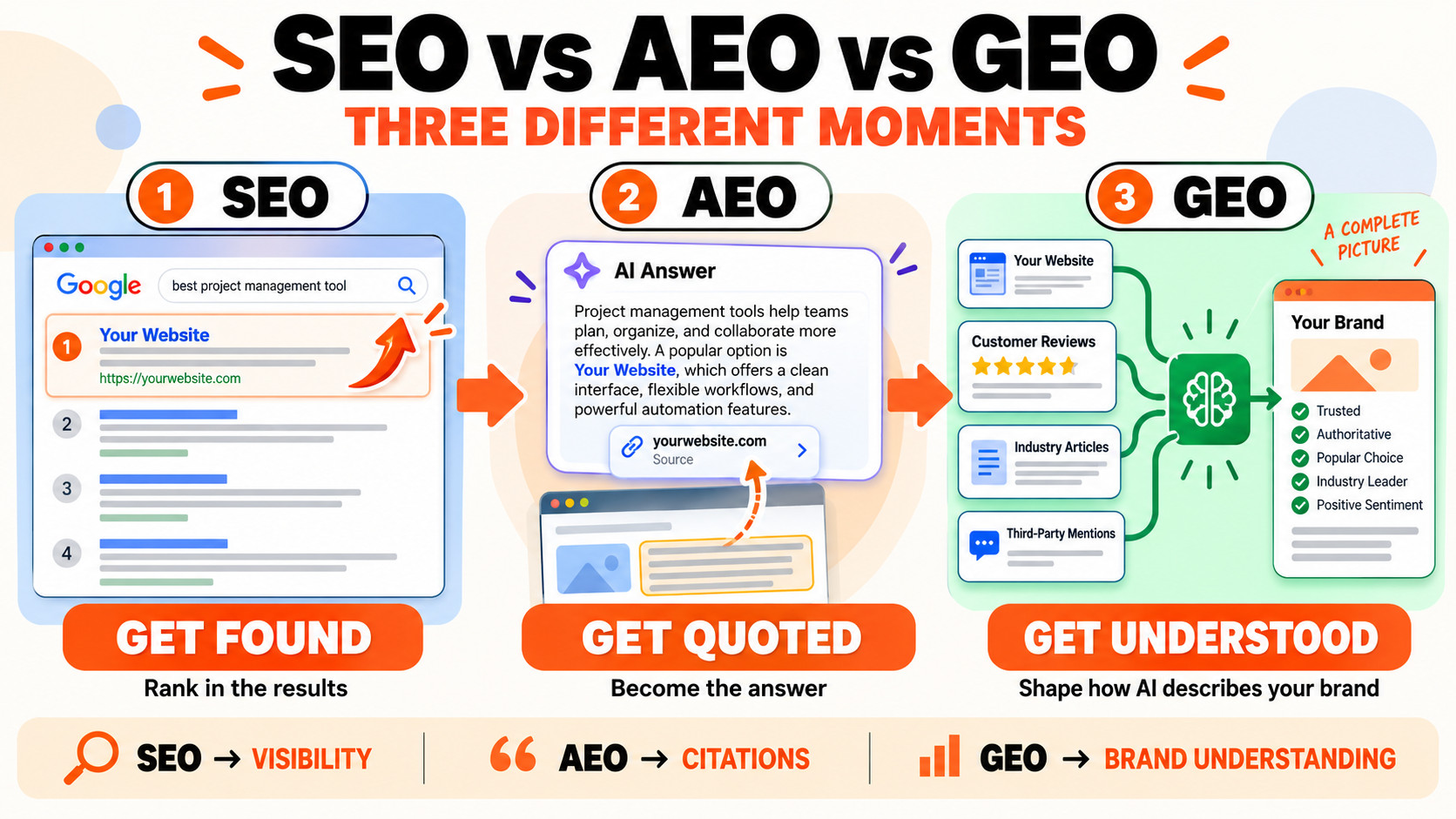
What is the difference between AEO and GEO?
The short version: AEO is about being the source an answer engine quotes for a specific question, and GEO is about how AI models represent your brand across many questions. AEO is page-and-query level. GEO is brand-and-entity level.
An AEO win looks like your paragraph being lifted into a Google AI Overview or a Perplexity answer, with a citation back to you. A GEO win looks like ChatGPT naming you when someone asks it to recommend a tool in your category, even without quoting a specific page. Do AEO well across enough pages and you tend to improve GEO as a side effect, because the models see you cited and mentioned more often.
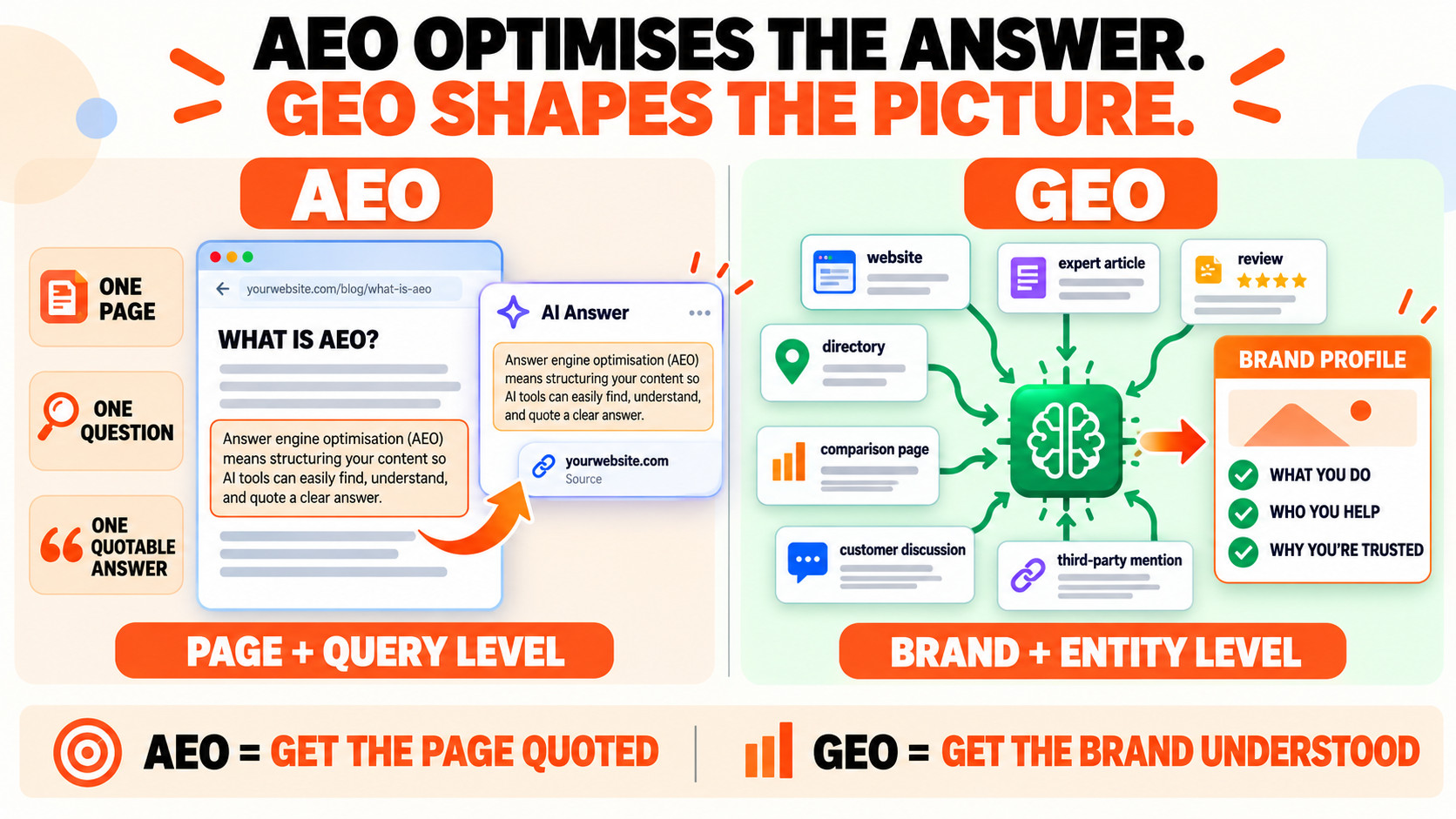
What is answer engine optimization (AEO)?
Answer engine optimization is the practice of structuring your content so AI answer engines can quote it directly and attribute it to you. It targets the systems that generate answers: Google AI Overviews, Perplexity, ChatGPT search, Gemini and traditional featured snippets.
In practice, AEO comes down to a handful of things you can measure and fix: open with a direct answer, use headings shaped like the questions people ask, write self-contained passages that still make sense when pulled out of context, and back claims with citable data and a visible author. You can score a page for this with an AEO Readiness Checker before you publish it.
What is generative engine optimization (GEO)?
Generative engine optimization is the practice of influencing how generative AI models represent your brand, product or expertise across their outputs. Where AEO asks “will the AI quote this page?”, GEO asks “when someone asks the AI about my category, does it know who I am, and does it describe me accurately?”
GEO is broader and fuzzier than AEO. It involves being present and consistent wherever models learn about the world: your own site, third-party mentions, reviews, directories, and the wider web the models train on and retrieve from. A practical starting point is to check what the models already say. Running your brand and your competitors through an AEO Citation Checker shows you whether AI cites you, mentions you, or does not know you exist yet.
How is SEO different from AEO and GEO?
SEO optimises for a ranking position in the list of organic results. It is still the foundation, because the same signals that help a page rank, relevance, quality, authority and good structure, also help it get quoted and mentioned. The difference is where the payoff lands. SEO earns the click. AEO and GEO earn the mention, which increasingly happens before anyone clicks anything.
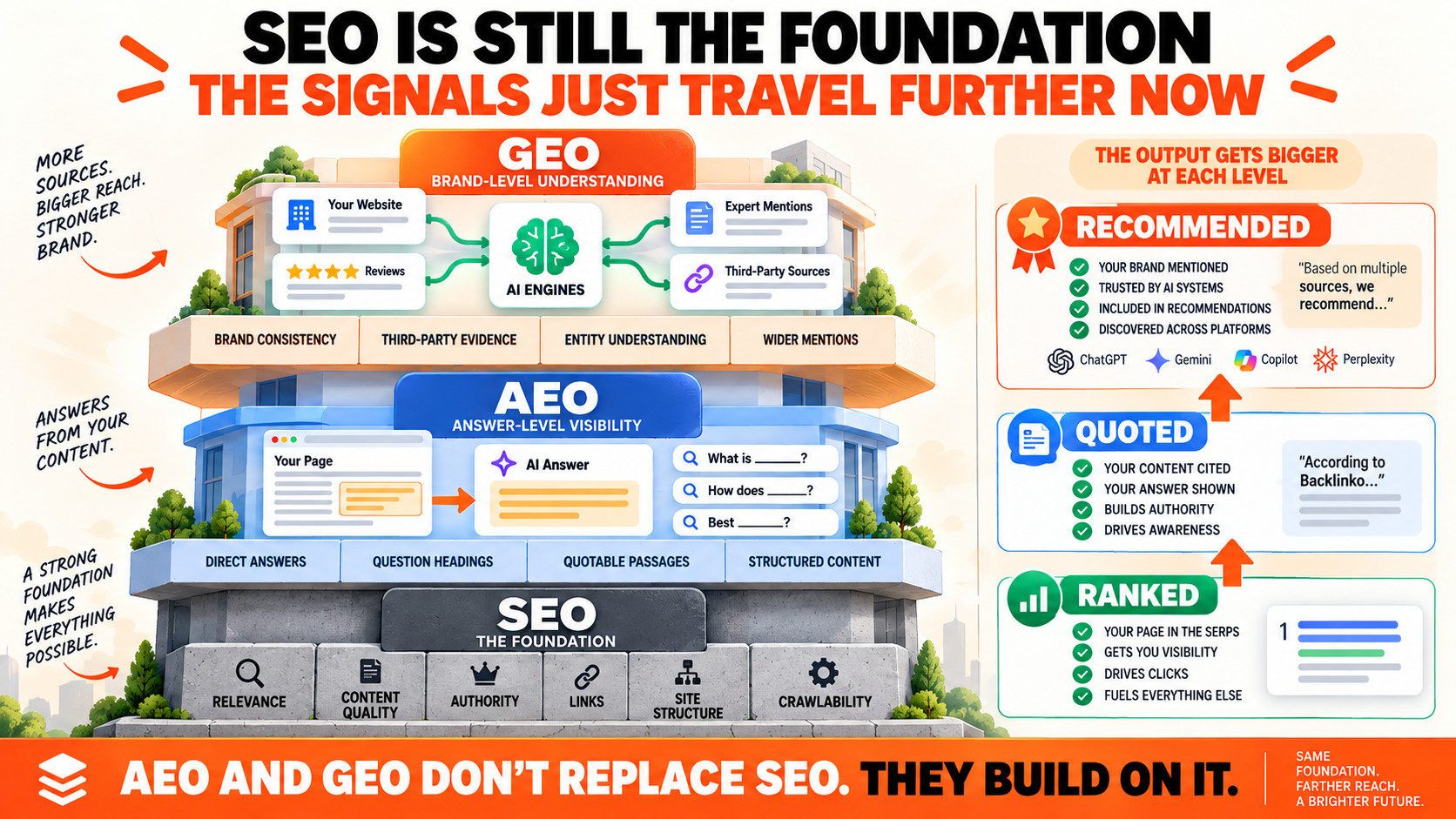
AEO vs GEO vs SEO compared side by side
AEO vs GEO vs SEO, side by side
| SEO | AEO | GEO | |
|---|---|---|---|
| Goal | Rank in the list of links | Be quoted as the answer | Shape how AI describes your brand |
| Where you show up | Organic search results | AI Overviews, Perplexity, featured snippets | Across generative answers and recommendations |
| Level | Page and keyword | Page and question | Brand and entity |
| Key tactics | Keywords, links, technical SEO, on-page | Answer-first writing, question headings, schema, citable data | Consistent entity, third-party mentions, being cited widely |
| How to measure | Rankings and organic traffic | Citations and snippet wins | Whether AI names and describes you correctly |
Do you need all three?
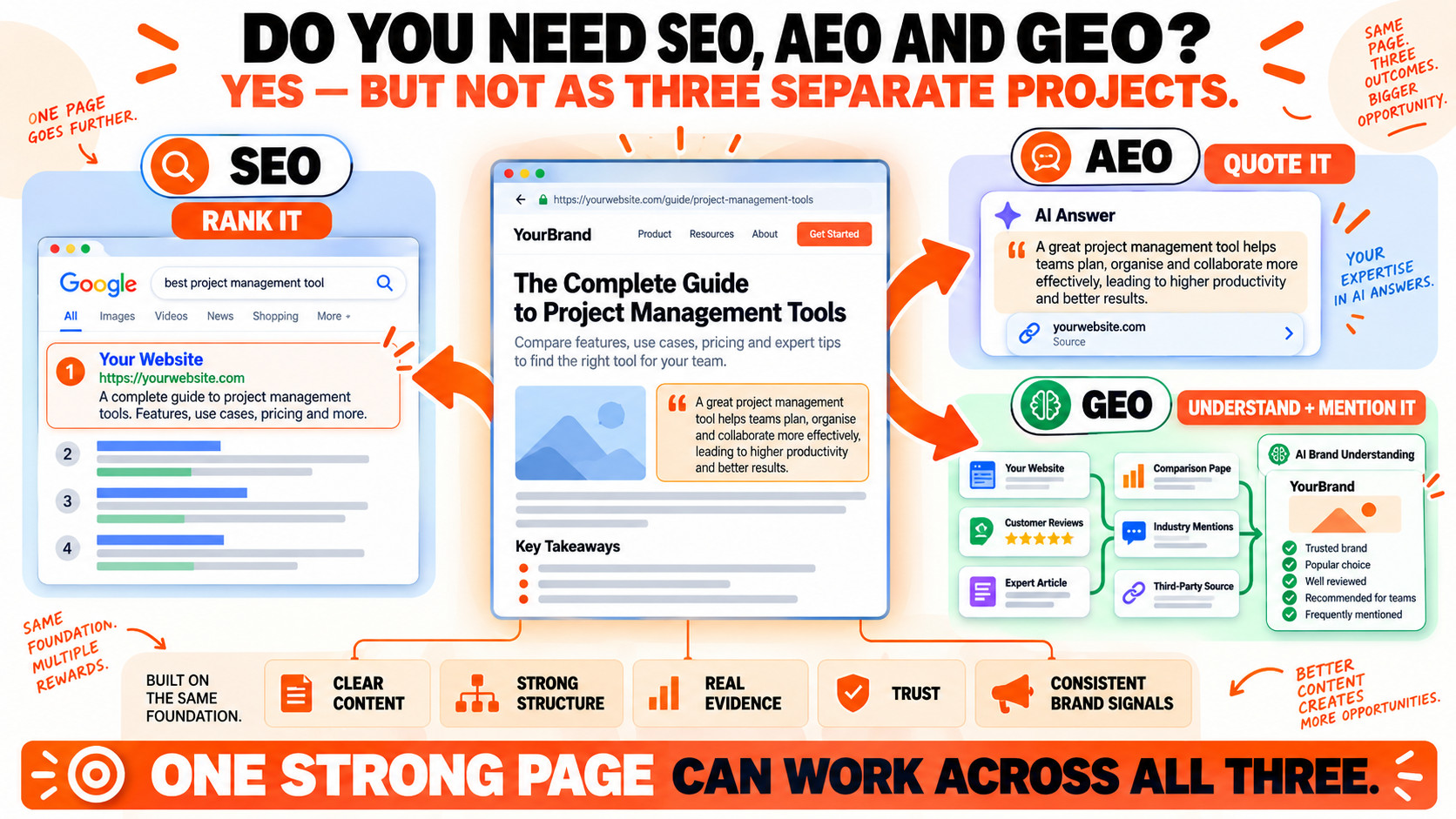
Yes, and they are not really separate projects. Strong SEO content that is well structured and trustworthy is the raw material AEO and GEO both draw on. The sensible order is: get the SEO fundamentals right, structure that content so it is liftable for AEO, and let consistent citations and mentions build your GEO over time. You do not pick one. You layer them.
If you are starting from zero, do not try to boil the ocean. Take the handful of pages that actually matter to your business, make each one answer-first and quotable, and check whether the AI engines pick them up. That is AEO working, and it is the fastest of the three to show a result.
How do you actually do AEO and GEO?
Practically, it is a short loop you repeat per page:
- Answer the question first. Put a direct, self-contained answer in the opening lines, then expand. The AEO Readiness Checker scores how liftable your opener is and will rewrite it for you.
- Structure for lifting. Use question-shaped headings, short quotable passages, a clear author and citable data. An on-page analysis catches the basics; a FAQ adds snippet-friendly Q and A.
- Check who gets cited. Run the prompts you care about through the AEO Citation Checker to see if the answer engines name you or a competitor, then close the gap.
- Repeat and widen. As more of your pages get quoted, the models see you more often, and your GEO improves without a separate campaign.
All of these run in your browser and are free to try. You will find the full set on the AEO tools page.
Frequently asked questions
Is AEO the same as GEO?
No, though they overlap and are often used interchangeably. AEO focuses on getting a specific page quoted as the answer to a specific question. GEO focuses on how generative AI models describe your brand across many answers. Good AEO tends to improve GEO over time.
Is SEO dead because of AEO and GEO?
No. SEO is the foundation both build on. The same content quality, structure and authority that help a page rank also help it get quoted and mentioned. What is changing is that ranking is no longer the only payoff, so you optimise for being cited as well as clicked.
Which should I start with?
Start with AEO on your most important pages, because it is the fastest of the three to produce a visible result and it feeds GEO automatically. Keep your SEO fundamentals in place underneath it.
How do I know if it is working?
Watch two things: whether your pages start appearing in AI Overviews, Perplexity and featured snippets (AEO), and whether AI assistants name and describe you correctly when asked about your category (GEO). A citation checker gives you the second one directly.
More in the Answer Engine Optimization Hub.
Intent SEO. Score every post for search intent and whether an AI can actually quote you, right inside the WordPress editor.
See Intent SEO →