New from Anthony Hayes: Aha Studio
Get found by the people searching for what you sell.
Local SEO and Google Business Visibility › Understand Local SEO Basics
Local SEO basics
A business two miles away can outrank one across the street, and the reason is rarely the map. Google first checks how well a profile matches what the searcher typed, then looks at how close the business is and how well known it is. Here's how that works and where to start if you want to move up.
A business two miles from the searcher can outrank one across the street.
The main reason is usually not the map.
When someone types local seo near me into Google, the search engine is trying to answer a simple question: which businesses fit this search best? Distance is part of that answer, but it comes after relevance. Google first decides which businesses match the search, then considers how close they are.
Google weighs how well a profile matches the search before it weighs how close the business is.
That order surprises most owners, because they assume the closest shop always wins. It doesn't. A profile that clearly says what you do, where you do it and who you serve can beat a nearer competitor whose listing is thin or vague.
In this post you'll get a plain breakdown of the three things that decide which nearby businesses show up: distance, relevance and prominence. We'll look at what relevance actually means on your Google Business Profile, why prominence takes time to build, and where to start if you want to move up.
We'll stick to the ranking side here. For the basics of how local SEO works, see our guide to what local SEO is, and for a to-do list, the local SEO checklist for small businesses covers it step by step.
The three ranking factors at a glance
| Factor | What it measures | Can you change it? |
|---|---|---|
| Relevance | How well the business matches the search | Yes, directly |
| Distance | How far the business is from the searcher | Mostly no |
| Prominence | How well known and trusted the business is | Yes, over time |
Find this useful? Add us as a preferred source on Google and more of what we publish will show up in your results.
How Google Decides Which Nearby Businesses Show Up
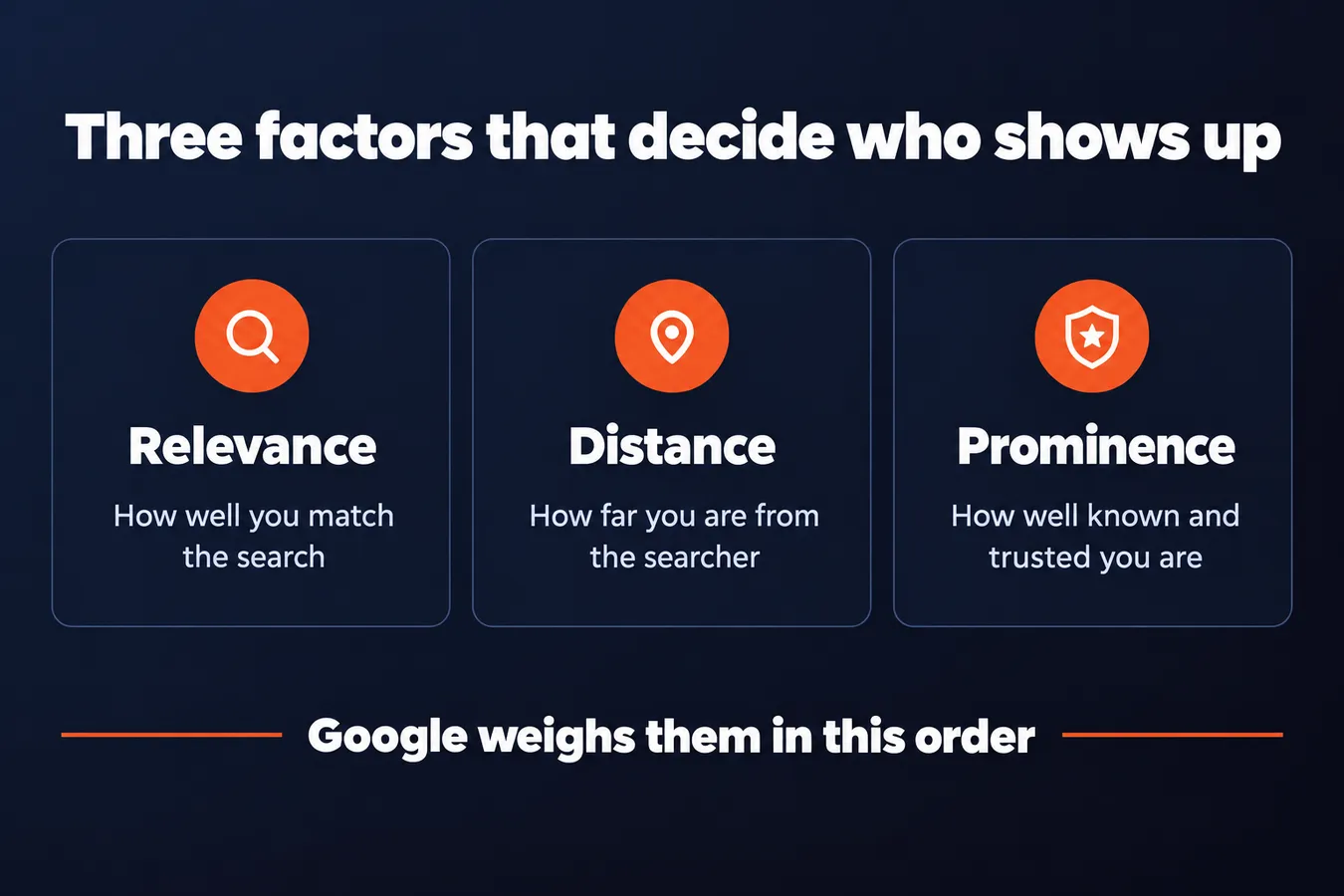
When someone types "local seo near me," Google doesn't just pick the closest company and call it a day. It sorts the candidates using three factors that Google itself names: relevance, distance and prominence.
Relevance is how well your company matches what the person searched for. If you're a plumber and someone types "emergency plumber," your listing and website need to say that clearly.
Distance is how far your business is from the searcher, or from the location named in the search. You can't change where your shop physically sits, so this one is mostly out of your hands.
Prominence is how well-known and trusted your business appears across the web. Reviews, links from other sites, and how often people mention you all feed into it. It's the factor most businesses can actually work on over time.
Your location and the wording of the search both shape the results.
Google looks at where the searcher is standing, or the place they named, and pulls businesses from that area. Then the words they used decide which of those businesses are even eligible. Someone searching "dentist near me" at 9pm on a Sunday gets a different set of results than someone searching "teeth whitening Tulsa," even if they're on the same street.
I see people get frustrated when they rank well for one search and vanish for a slightly different one. Usually the wording changed, and their description didn't keep up.
Here's the thing about place.
A company can't rank for a town it has no real connection to. If your office is in one city and you've got no customers, reviews or citations there, Google has no reason to show you to people searching there. Stuffing a neighboring town's name into a page doesn't fix that.
Real connection looks like a physical address, a service area you actually serve, and local mentions that show up across the web. Without that, the distance and prominence signals simply don't line up with the place you're chasing.
Where each factor gets its signal
| Factor | Main source | Example |
|---|---|---|
| Relevance | Your profile and website wording | Service list using searched terms |
| Distance | Searcher location and business address | Business physically nearer the searcher |
| Prominence | What other people and sites say | Reviews and links from local sites |
Why Distance Matters Less Than You Think
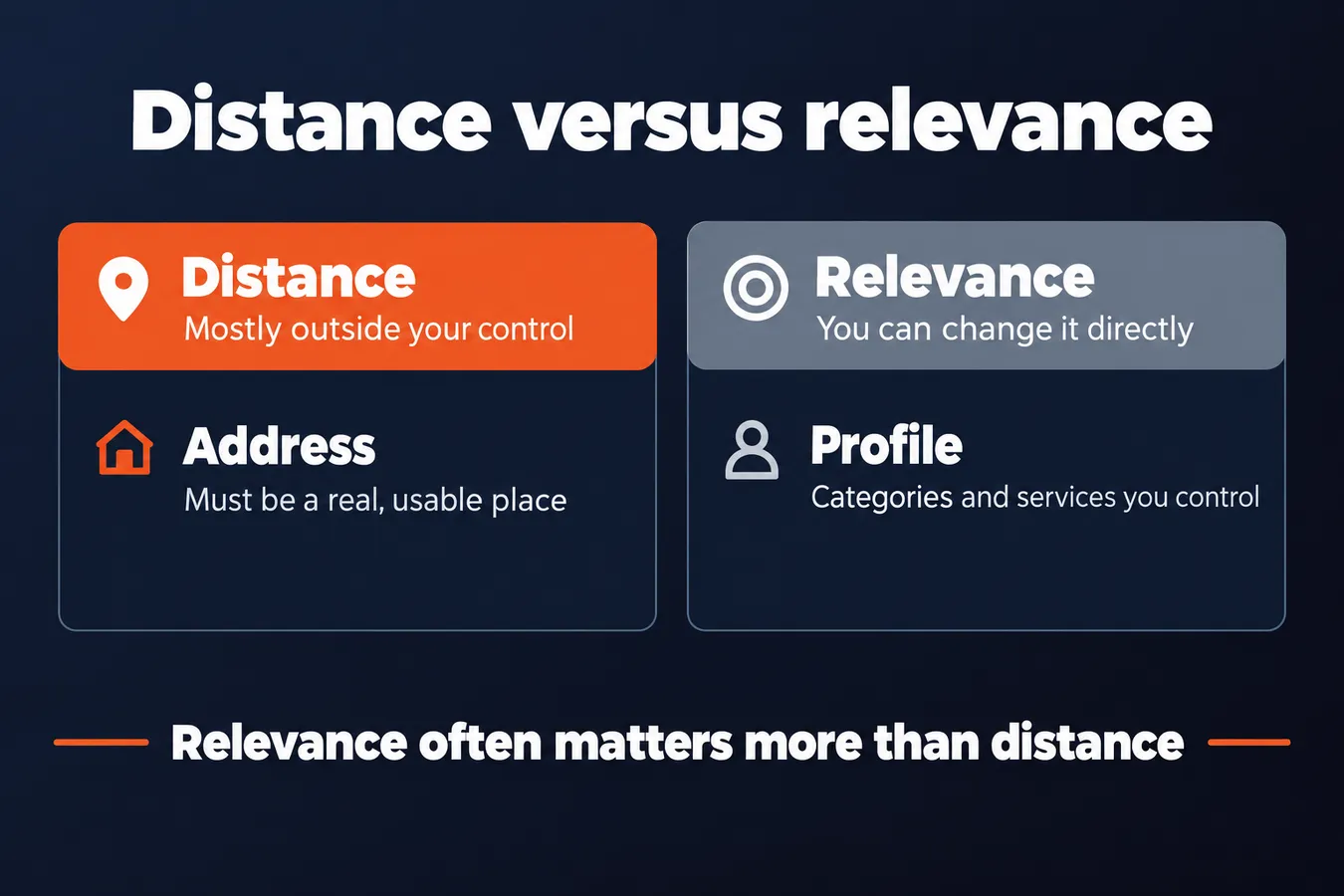
Distance is one of the three things Google looks at for near-me searches, but it's rarely the one that decides who wins. Relevance and prominence usually do more of the work.
Google uses the searcher's location to decide which area to search in. If someone types "plumber near me" from a phone in Ealing, the results come from businesses that are relevant to plumbing and close enough to make sense for that spot. Move the same search three miles away and the list can shift quite a bit, because the nearby competitors are different.
That's why the rankings change from one neighborhood to the next. The competition is local, so what counts as "close" depends on how many good businesses are packed into the area around the searcher.
You can't move your address to win. Google wants the listed address to be a real place where customers can actually go, and a fake or shared address gets flagged fast. [CHECK: confirm current Google Business Profile guidelines on virtual offices and mailboxes before publishing.]
If you're a service-area business (a plumber, a locksmith, a mobile detailer who drives to the customer), you can hide your street address and list the areas you serve instead. That's the legitimate route. You still need a solid profile, reviews, and pages on your website for each area you actually cover.
The map pin is where the trouble starts for businesses near a boundary. Google places the pin at your listed address, and a search from just across a city line or a main road can favor the company whose pin sits closer. Being one street off can cost you visibility in one direction and gain it in another.
If you're near the line, the fix isn't to move. Build out content and reviews that name the neighborhoods on both sides, so Google has more reasons to show you to people in both places.
What Relevance Looks Like on Your Google Business Profile
Relevance is the part of local ranking you control most directly. Google has to decide what your business is, and your profile is where you tell it.
Start with your primary category. Choose the one that describes what you mostly do. Google weights it more heavily than anything else in your profile, so it's the one to get right before you touch the rest.
Secondary categories are for the real extras. If you're a plumber who also does drain cleaning and water heater installs, those can go in as secondary categories. Don't stuff in categories you only do occasionally, because it muddies the signal.
Your business description is where you say, in plain words, what you do and where. Write it the way a customer would describe the problem. A person searching for "emergency furnace repair" doesn't type "comfort solutions provider," so don't write it like that either.
The service list works the same way. Use the exact terms people type, like "drain cleaning" or "hair color" or "same-day dog grooming." If your list says "Residential Solutions," that is not a phrase anyone types into a search box, so Google has nothing to match.
Consistency is the boring part, and it matters. Your name, address and phone number need to look identical everywhere they appear: your profile, your website, your directory listings and your social pages. If one listing says "Suite 4" and another says "#4," or you have an old phone number floating around, Google gets less confident about which company you are.
I've seen this go wrong more than once. An old listing with a different phone number just sits there and quietly pulls the data apart, so check the directories you've forgotten about too.
How Prominence Builds Over Time
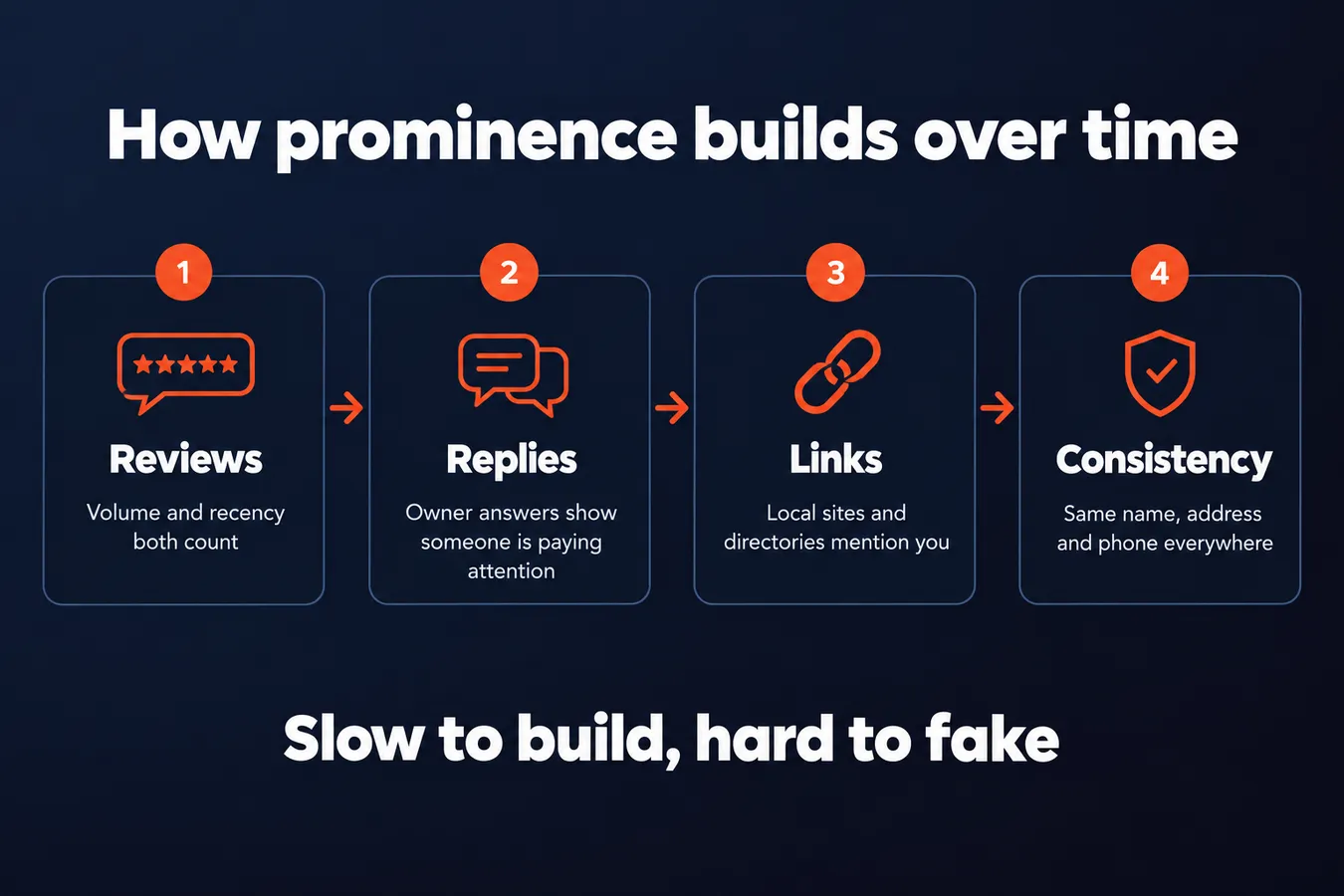
Prominence is how well known and trusted a business looks to Google. Distance and relevance get you into the running, but prominence often decides who wins when two businesses are equally close and equally relevant. It's built from the outside: what other people and sites say about you.
Reviews are the most visible part of it. Volume matters, so a business with 200 reviews usually beats one with 12, all else equal. Recency matters too. A steady trickle of new reviews tells Google you're still operating and still getting customers.
The rating itself counts, but not as much as people think. A 4.8 with a handful of reviews won't beat a 4.6 with hundreds. Replies matter as well. When the owner answers reviews, good and bad, it shows someone is paying attention. I've seen this pattern across the local sites I've worked on, though I wouldn't put a number on how much it moves rankings.
Links and mentions work the same way. A local chamber of commerce listing, a directory, a supplier's page that names you, a local news story: each one is a signal that the web knows you exist in that place. Consistent name, address and phone details across those sources help too, because they stop Google guessing which company you are.
Prominence is slow, and that's the point.
Reviews come in one customer at a time. Links come from places that take weeks or months to approve, write about you or notice you. You can't buy a year of steady reviews overnight without it looking odd, and Google has seen plenty of attempts to fake them. That slowness is exactly why it's hard to fake. A competitor can't shortcut it in a week, and that's what makes an established local presence worth protecting.
Where to Start If You Want to Move Up
If you're not showing up for your near-me searches, don't start by rewriting your whole website. Start by finding out which of the three factors is holding you back.
Check your own profile against the three factors first.
Distance is the one you can't change much. Google looks at where the searcher is standing and where your company is located, and you can't move your office closer to every neighborhood in town. So skip that one for now.
Relevance and prominence are where most small businesses fall short. Look at your Google Business Profile and ask whether your categories, services and description say plainly what you do. Then check whether your company is listed consistently across the directories that matter, and whether reviews are coming in at a steady pace. Whichever of those looks weakest is your starting point.
Search your own near-me terms from a few spots around town.
Pick the phrases a customer would really type, like "plumber near me" or "accountant near me," and run them from at least three locations: your shop, a spot a few miles away, and somewhere on the other side of town. Searching from home or the office won't tell you much, since Google uses your current location.
Write down who shows up in the map pack and in the organic results each time. Note how many reviews the top results have and what their categories say. You'll usually see the pattern within a single afternoon.
Now, the next one is the part people skip. Don't just look at who ranks. Look at why they might rank, and compare that with your own profile.
What to expect in the first few months.
Changes to local rankings don't happen overnight. Profile edits can take days or weeks to show up, and new reviews build up gradually. Consistency across directories is slow to clean up, especially if old listings are scattered around.
So judge progress over months, and check your searches again every few weeks, keeping a simple log. You'll see movement, even if it's small at first, and that log is what tells you whether the change you made was the right one.
Frequently asked questions
Does distance matter at all for near-me searches?
Yes, but it usually isn't what decides who wins. Google uses the searcher's location to pick the area, then ranks businesses by relevance and prominence within that area. You can't move your address to win, so spend your effort on the factors you can actually change: your profile's categories and description, your reviews, and how consistently your business is listed across the web.
Can I rank for a town I don't physically operate in?
Not really. Google needs a real connection to the place, like a physical address, a service area you actually serve, reviews and mentions from that area. Stuffing a neighboring town's name into your page doesn't create that connection. If you're a service-area business, list the areas you cover and back them up with a solid profile and reviews from those places.
How long does it take to see changes in local rankings?
Usually months rather than days. Profile edits can take days or weeks to show up, new reviews build up gradually, and cleaning up inconsistent listings across directories is slow. Check your near-me searches from a few spots around town every few weeks and keep a simple log, so you can see whether the changes you made are moving things.
Aha Studio
Get the next playbook first
New playbooks and LaunchWatch reports land in Growth Signals, the free newsletter, along with the case studies and how-tos I find worth stealing.
More in Understand Local SEO Basics
- What Is Local SEO and How Does It Work? A Plain-English Guide for Business Owners
- Local SEO Checklist for Small Businesses: 15 Steps in the Order to Do Them
- 14 Common Local SEO Mistakes That Hold Businesses Back
Explore the full Local SEO and Google Business Visibility hub