
Keyword Research › Keyword Research Fundamentals
SEO Keyword Planning
Turn a collected keyword list into a clear page plan by grouping terms around search intent and deciding which deserve their own pages. You’ll weigh search volume, ranking difficulty, and business fit before you set priorities.
A long list of related search terms can often become a shorter, clearer plan: group phrases by intent, then give each distinct need its own page.
Keyword research and analysis for SEO helps you sort opportunities into groups you can act on. To assess and organize them:
- Remove duplicates and phrases that don’t fit.
- Group related phrases by topic and search intent.
- Compare search volume, ranking difficulty, and business fit.
- Decide which groups belong on the same page.
- Prioritize the plan and review performance.
By the end, you’ll have a practical way to move from a spreadsheet of terms to a focused set of pages.
I’m Tony Hayes. I’ve been building marketing software since 2011, and I build everything with AI without writing code myself.
Here, we’ll clean and group your list, identify intent, assess volume, difficulty, and business fit, then decide which terms share a page.
We’ll finish by prioritizing the plan and reviewing performance. If you’re looking for the wider process, see our practical guide to SEO and keyword research; this article focuses on assessing and organizing opportunities you’ve already collected.
The steps at a glance:
- Clean and group your keyword list
- Identify the intent behind each group
- Assess volume, difficulty, and business fit
- Decide which terms share a page
- Prioritize the plan and review performance
Find this useful? Add us as a preferred source on Google and more of what we publish will show up in your results.
Step 1: Clean and group your keyword list
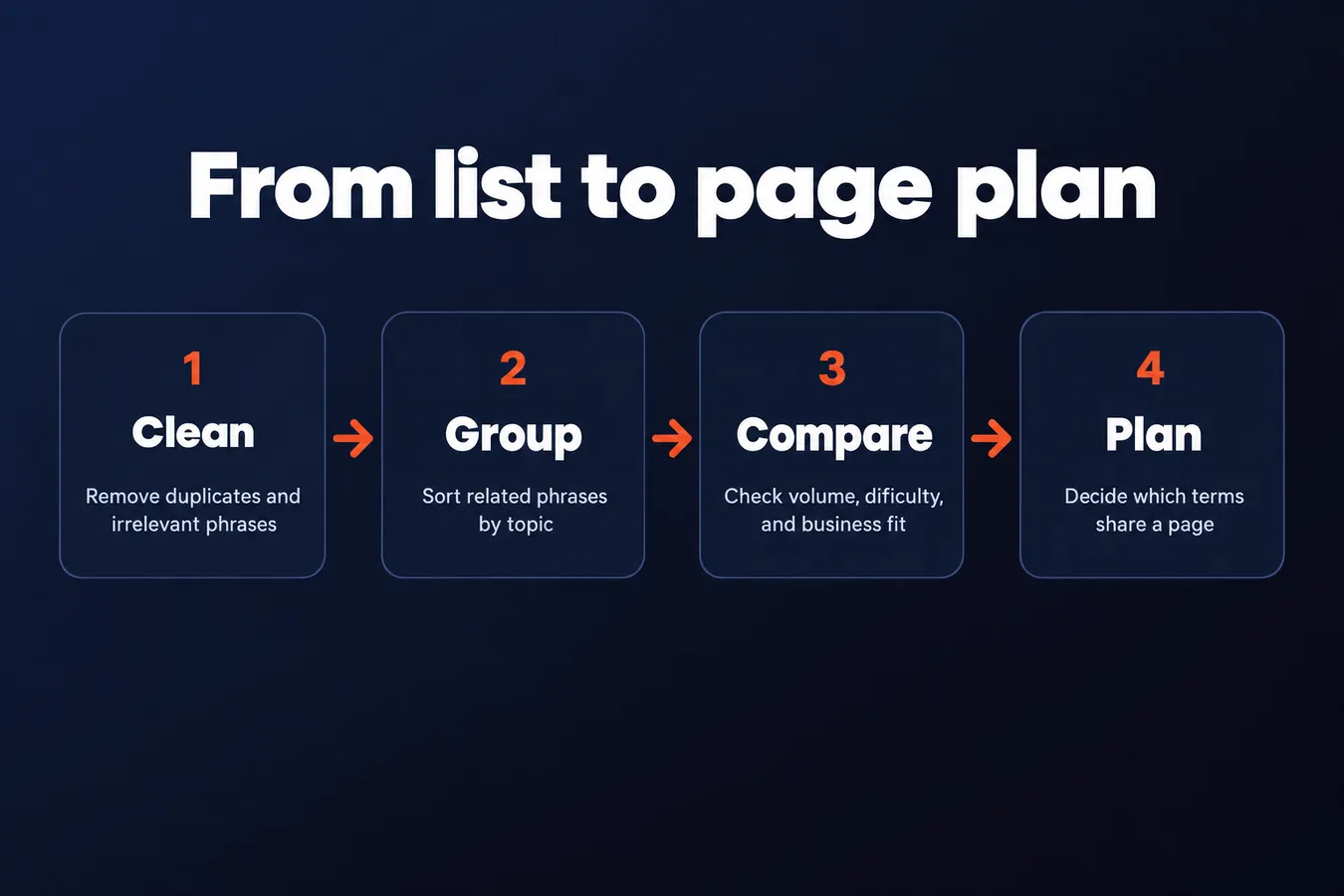
Raw keyword research can get messy fast. Start by removing duplicates, irrelevant phrases, and anything that doesn’t fit your audience, offer, or website.
A phrase with high search volume still has little value if it attracts the wrong people. Keep opportunities connected to what you offer and the material you can create.
Your goal is a list you can make decisions from.
Next, group close variants by topic. Short-tail and long-tail keywords can belong together when they share the same subject and search intent.
For example, a broad phrase and a more specific one may call for the same page. Group them under one topic label, then review whether the intent fits what you plan to publish.
Keep the original searches alongside your normalized topic labels. That way, you can sort and plan around clear themes without losing the language people actually use online.
Keep the useful wording. Clean up the structure.
Use Google Keyword Planner, Semrush, or a spreadsheet to sort and review the list. You can group by topic, compare search volume, and check that each cluster matches your SEO strategy and audience.
This step gives you a manageable set of opportunities to assess. It also makes it easier to decide which topics belong on your website and which phrases should stay off the list.
Step 2: Identify the intent behind each group
A keyword tells you what someone typed. Intent tells you what they want.
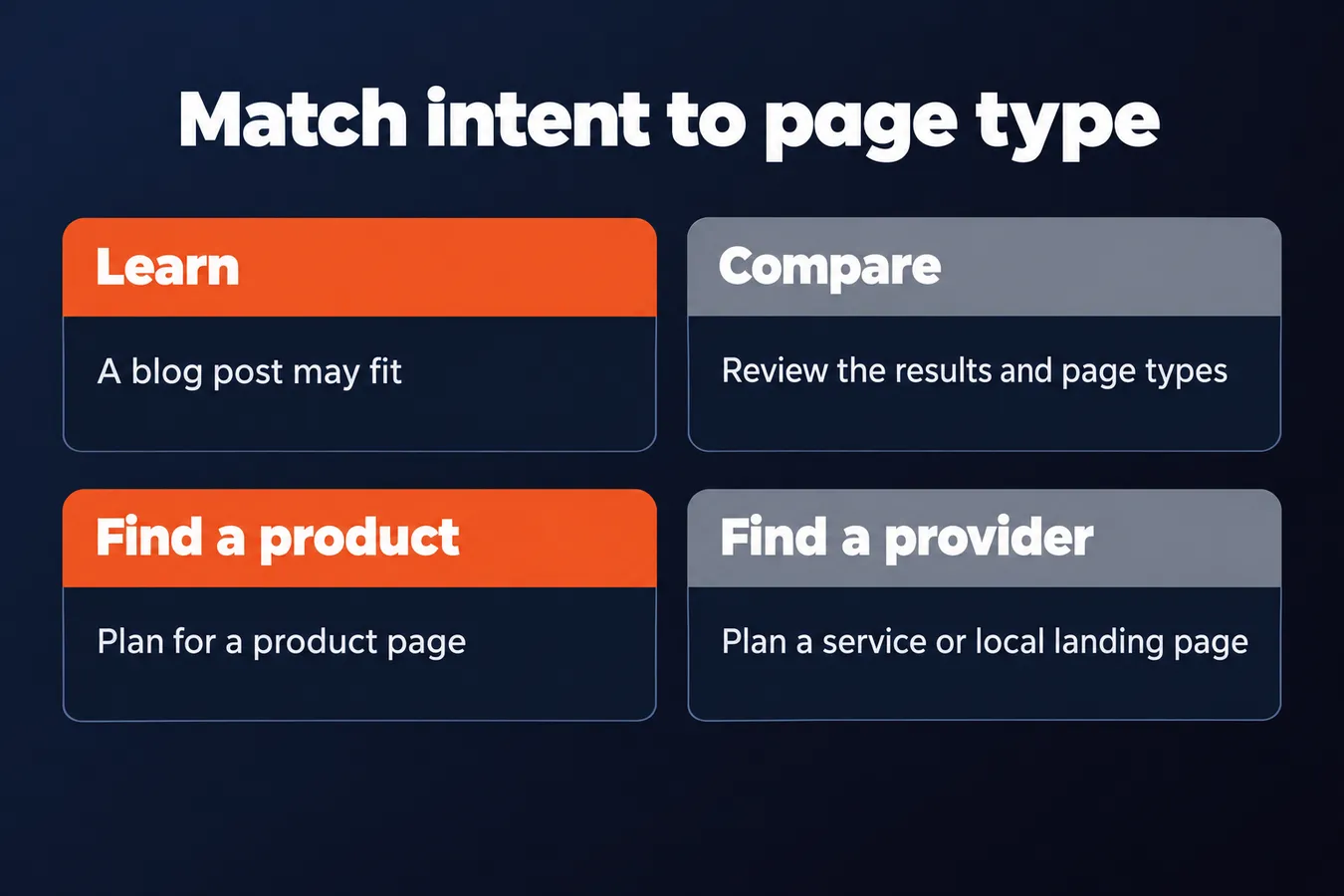
As you organize terms from your research, group them by the searcher’s goal. Are they learning about a topic, comparing options, or looking for a product or service? That goal points you toward what your audience expects.
Search Google for a few representative phrases in each group. Look at the results and the type of material they contain. If the results are mostly guides, a blog post may fit. If they’re product listings, service pages, or local landing pages, plan for that type of page.
Tools such as Semrush can help you review keywords and volume, but Google’s results show you what’s already being served for those terms. Use both as inputs to your SEO strategy.
Similar wording can hide different intent.
For example, a search for information about a service may call for a blog post, while a search for a provider may call for a service page or local landing page. Keep those phrases in separate groups when the intent or expected format differs.
That distinction helps you choose a target keyword for each page and gives your material a clear job on your website. If one group points to a product page and another to an educational guide, give each its own plan.
Step 3: Assess volume, difficulty, and business fit
Search volume gives you a rough sense of how often people search a keyword. Treat it as a directional measure, since estimates from tools like Semrush can vary. Check seasonality and location-specific demand too, especially if your website serves a particular area or offers something people need at certain times of year.
Volume helps you compare terms. It doesn’t decide what you target.
Next, look at the pages Google already ranks for each keyword. Do they match the search intent? Are they thorough and closely connected to the topic, or do they answer a different need? This gives you a more grounded view of ranking difficulty than a score from a tool alone.
The current rankings also show you what kind of material the search calls for. A phrase may look achievable on paper, but the results can reveal a narrow intent your planned work won’t satisfy.
Then ask whether the audience and their need connect to what your business offers. A phrase can attract plenty of traffic and still send the wrong people to your website.
I’d rather target a relevant opportunity you can realistically serve.
As you organize your keyword research, compare volume, ranking difficulty, and business fit together. A high-volume opportunity with weak relevance can pull your SEO strategy off course. A smaller, achievable phrase that matches your material and audience is often a better opportunity.
Three checks for each keyword opportunity
| Factor | What to check | How to use it |
|---|---|---|
| Search volume | Search frequency, seasonality, location | Directional measure |
| Ranking difficulty | Current pages and search intent | Assess results, not just tool scores |
| Business fit | Audience, search need, and offer | Prioritize relevant opportunities |
Step 4: Decide which terms share a page
Now group the keywords by search intent. When several phrases point to the same need, assign them to one target page and use the clearest phrase as its primary topic. The other terms become supporting topics within the same content.
Search results in Google can help you judge intent. Check whether similar phrases bring up the same kinds of pages, then compare that with what your audience needs. Volume from keyword research tools such as Semrush is useful context, but it doesn’t decide the page map on its own.
One shared need usually belongs on one page.
Give distinct needs separate pages when one page would struggle to answer both well. A person searching for a guide and a person looking for a specific product need different material, even if their keywords overlap. Match the page to the job the searcher wants done.
Then check your website for overlap. Compare each planned group with existing pages that cover similar terms. If an existing page already serves the same intent, update or expand it before creating another that competes for the same search.
I’ve spent years building marketing software, and I keep this part of keyword analysis practical: each group should have a clear home. A tidy map makes it easier to plan content and gives every page a defined target.
For each group, record the target page, primary topic, supporting terms, and intended format, such as a guide, service page, or landing page. This gives your SEO strategy a clear structure, from the phrase you’re targeting to the content you’ll publish.
Step 5: Prioritize the plan and review performance
A keyword list becomes useful when it tells you what to publish first. Rank each opportunity by relevance to your audience, intent match, difficulty, search volume, and business value.
The best target keyword is the one that fits your website and your goals.
A high-volume term can look tempting, but it may bring the wrong audience or call for work your business can’t support. Use tools such as Semrush to compare phrases, then judge the numbers alongside what the searcher wants and what your business offers.
Choose a manageable first batch of pages. Include a few stronger opportunities that need new content and quick wins on existing pages, such as updating a page that already targets a related keyword or search intent.
Start with a plan you can publish and maintain.
For each page, record its target keyword, the related terms it should cover, and the job the content needs to do. That gives you a clear strategy without turning every keyword into a separate page.
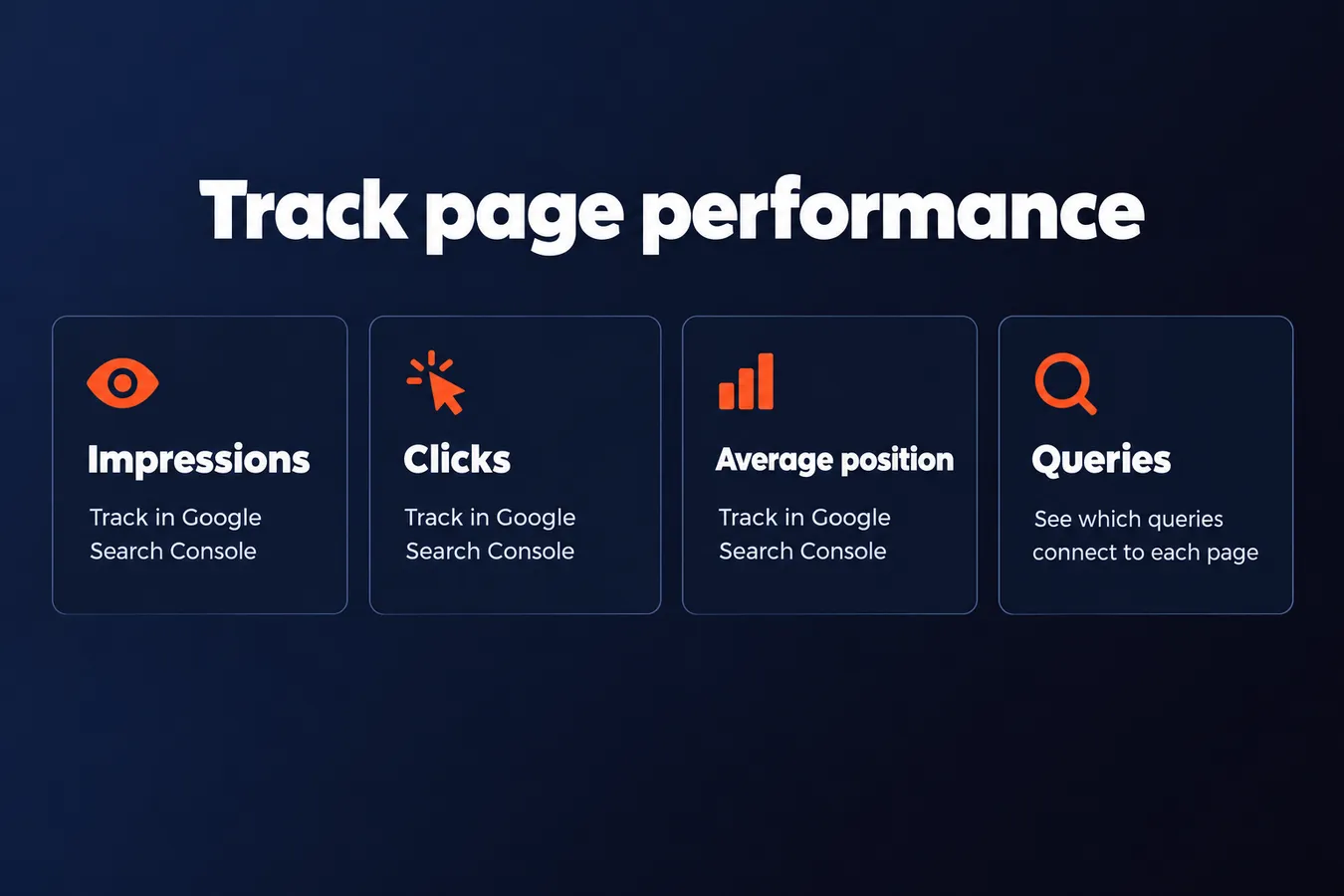
Once pages are live, track target queries and page performance in Google Search Console. Watch for changes in impressions, clicks, average position, and the queries Google connects with each page.
Search data develops over time, so revisit the plan as it comes in. A page may start appearing for useful terms you didn’t target, or a keyword may prove less relevant than your research suggested. Use those signals to adjust the content, refine the target, or move another opportunity up the publishing plan.
Frequently asked questions
How do I group keywords into useful clusters?
Remove duplicate and irrelevant terms, then group close variants under a topic label. Keep the original search terms visible so you retain the language people use. Check that each group shares a subject and search intent before deciding what page it belongs on.
How can I tell whether keywords should share a page?
Compare the search intent and the page types showing in Google results for each term. When several terms point to the same need, they can share a target page, with one primary topic and the others as supporting terms. Give distinct needs separate pages when they require different content.
How should I assess a keyword beyond search volume?
Compare volume with ranking difficulty and business fit. Review the pages already ranking in Google to see whether they match the intent and how closely they cover the topic. Then ask whether the searcher’s need connects to what your business offers.
How do I check whether a keyword plan is working?
After pages are live, track target queries and page performance in Google Search Console. Watch impressions, clicks, average position, and the queries Google connects with each page. Use what you learn to adjust the content, refine a target, or prioritize another opportunity.
My Take: That work keeps my keyword analysis tied to what a business actually does. I want each group to have a clear home, and each page to have a clear job. So I keep the original search terms visible, check intent in Google, and weigh volume alongside business fit. A tidy keyword map gives you a plan you can publish and maintain. It also gives you a way to review performance and adjust the plan as search data comes in.
Aha Studio
Get the next playbook first
New playbooks and LaunchWatch reports land in Growth Signals, the free newsletter, along with the case studies and how-tos I find worth stealing.