New from Anthony Hayes: Aha Studio
Get found by the people searching for what you sell.
Local SEO and Google Business Visibility › Paid Local Visibility
Local SEO vs Google Ads
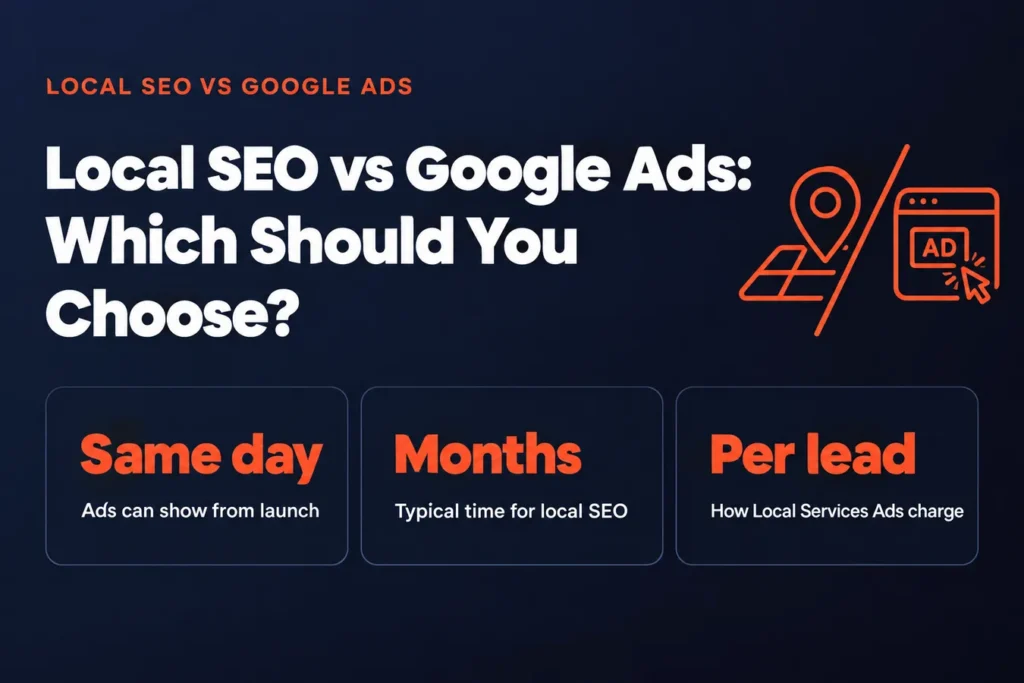
Local SEO and Google Ads both put your business in front of people searching nearby, but they cost you different things and pay off on different timelines. This guide walks through cost, speed, lead quality and durability so you can pick the one that fits your budget and your patience.
Google Ads can put your business at the top of the results the same day you set it up, but the moment you stop paying, that traffic is gone.
If you're weighing up local SEO vs Google Ads: which should you choose, you're really asking how you want to pay for visibility. One option rents it by the click. The other builds it over time and keeps it around.
Here's what you'll get from this post: a straight comparison of the two, based on the things that actually matter when you're spending money.
We'll look at what each option is, where the money really goes, how fast leads show up, how much control you get over who calls you, and what happens to your phone when you switch off the spend.
I've been building marketing software since 2011, and I've watched plenty of local businesses try both. Some did well with paid ads first and moved to organic later. Others had the opposite experience. The right answer depends on your situation, and I'll show you how to work that out.
By the end, you'll have a clear way to decide which one to start with, and when it might make sense to run both.
We'll start with what each option actually is, because a lot of confusion comes from people mixing them up.
Local SEO vs Google Ads at a glance
| Option | Best for | Cost model | Speed to leads | Lasting after spend stops |
|---|---|---|---|---|
| Local SEO | Steady long-term lead flow | Time or agency fees, low upkeep | Months, depends on competition | Yes, if profile is maintained |
| Google Ads (search) | Leads needed now | Pay per click or call | Days after launch | No, stops when budget stops |
| Google Maps Ads | Map placement with paid spend | Not stated | Not stated | Not stated |
| Local Services Ads | Eligible trades, predictable budgets | Pay per lead | Not stated | Not stated |
| Local SEO plus Google Ads | Cash flow while organic builds | Ads spend plus upkeep | Ads now, organic later | Partly, organic remains |
Find this useful? Add us as a preferred source on Google and more of what we publish will show up in your results.
What Each Option Actually Is
Local SEO is the work of making your business easy to find when someone nearby searches for what you do. That means tidying up your Google Business Profile, tightening up your website, and making sure your listings match across the directories that matter. Do that well and you can show up in the map pack (the three-business map block at the top of local results) and in the regular organic results below it. It's free to appear there. You pay in time and effort instead.
Google Ads is different. You pay Google to put your business in the sponsored results and on Google Maps. You're billed per click on a search ad, and for some formats per call. Google Maps ads work on a similar basis, so you're paying to be seen on the map rather than earning a spot on it.
There's also Local Services Ads, which is a separate format for certain trades. Instead of paying per click, you pay per lead. Google charges when someone contacts you through the ad, and it does not charge just because they looked at it. That's a different deal, and it only applies to the service categories Google has opened up, so check whether your trade qualifies before you plan around it.
The big difference is time. Local SEO earns its position slowly. It builds up as Google sees your profile being active, your reviews coming in and your site answering the right questions. Ads buy you the spot the moment the campaign goes live. Turn the budget off and the visibility goes with it.
Cost: Where the Money Goes
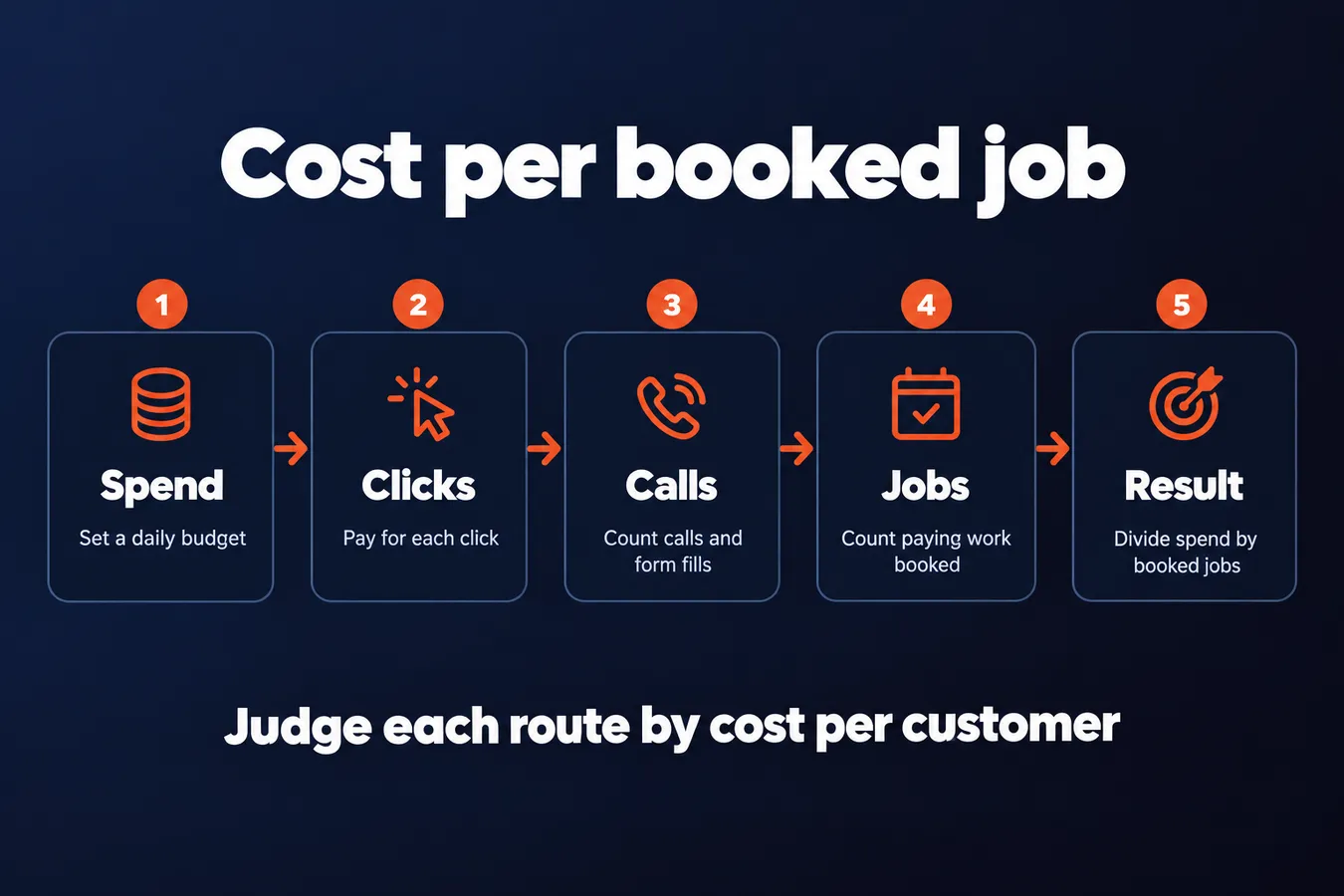
Google Ads has a visible, recurring cost. You set a daily budget, you pay for each click, and your spend and your leads rise and fall together. Turn the budget up and the phone rings more. Turn it off and it stops.
Local SEO works differently. Once it's working, the monthly cost is usually lower, because you're paying for upkeep rather than for every visitor. The catch is the front end. The early months cost you time or agency fees, and the payoff is slow to show on a spreadsheet. You won't see the return in the first week, or probably the first month.
That's the part people get wrong when they compare the two. A cheap click still costs money if no one books.
So compare them on cost per booked job or cost per customer. A $4 click that never converts costs you more than a $25 click that turns into a job. Work backward from what a booked job is worth to you, then ask which route gets you there for less.
For ads, that's simple to track. Count the calls and form fills, count how many become paying work, and divide your spend by that number. For local SEO, you'll need to be a bit more careful, since calls and directions requests from your Business Profile don't always get tagged to a source. Set up call tracking and ask every new customer how they found you. It's not perfect, but it beats guessing.
If you run a local service business, the Google Local Services Ads page covers how that particular format charges. For Maps placement, see the Google Maps Ads page in this hub. Both change the math, so check them before you commit a budget.
Speed: How Fast You See Leads
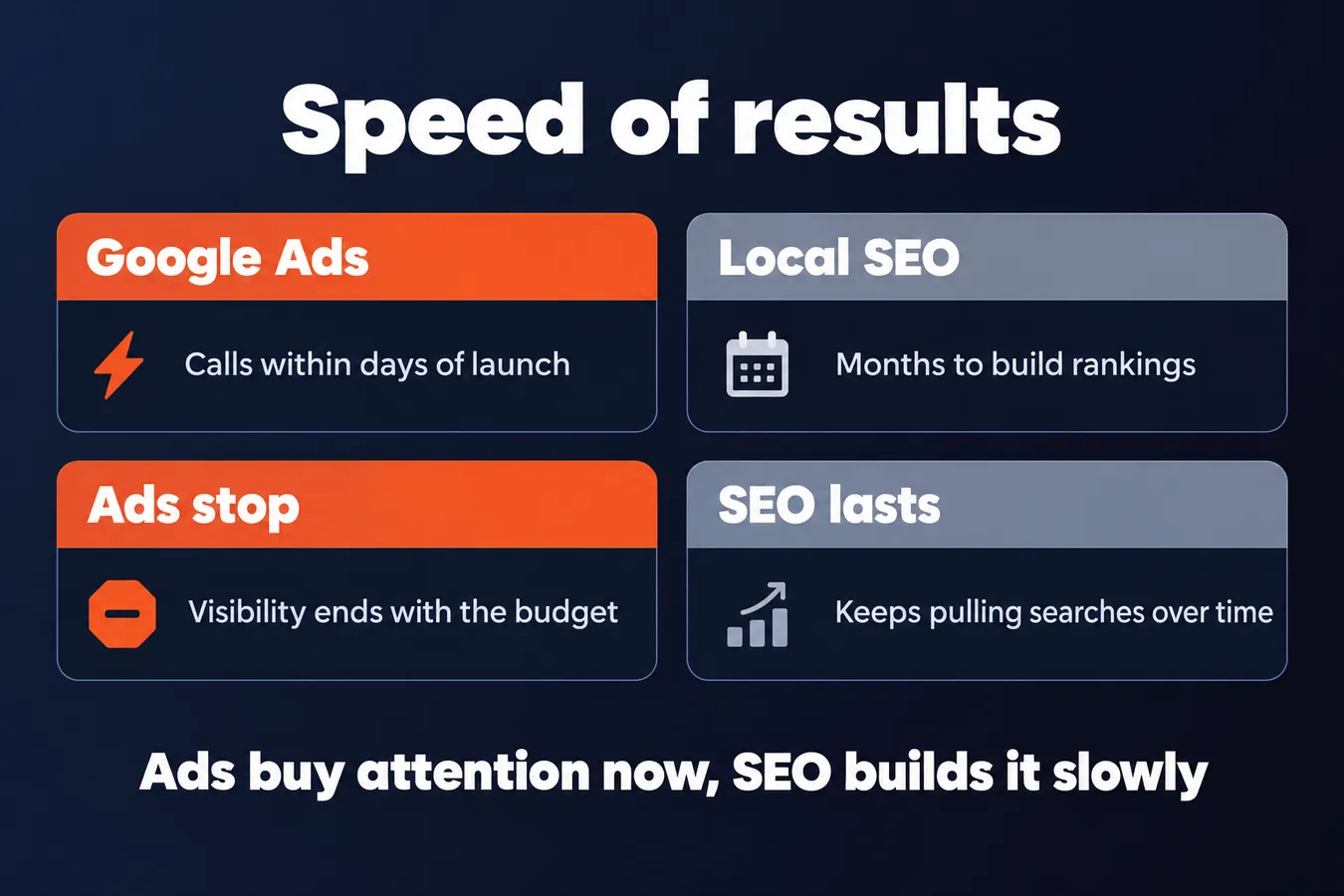
If you need work next week, ads are the honest answer. A well-built campaign can start generating calls within a day or two of launch. That's the big draw of Google Ads: you pay, and the people searching for your service see you at the top of the page almost right away.
Don't trust the numbers yet, though. You'll usually need a week or more of data before you know which keywords bring in real calls and which ones just burn budget. The first few days are for watching, and the decisions come after.
Local SEO works on a much longer clock. In a competitive area, it commonly takes several months to move your rankings, and how long depends heavily on how many businesses are already fighting for the same searches. A plumber in a small town with few competitors may see movement faster than one in a big metro with a dozen established sites. [CHECK: confirm the author's own experience with timing, if any, before publishing]
That's the trade. Ads buy you attention today, and the moment you stop paying, the calls stop too. SEO builds a page and a profile that keep pulling in searches month after month, but you have to wait for them to take hold.
So the timing question is simple. If you need work next week, run ads. If you can wait six months for a steady flow of leads, put the effort into local SEO and let it compound.
Many local service businesses end up doing both, with ads covering the gap while the organic side grows.
Lead Quality and Control
With ads, you decide who sees you. You pick the keywords, the ZIP codes you serve, and even the hours your ad runs. That means you can cut off the job seekers and tire-kickers who click out of curiosity but never buy.
Those clicks cost money, though. You pay for every one, including the ones that were never going to become customers.
The upside is that you can tighten things as you go.
Local SEO works differently. No one is paying to put you in front of someone, so you don't get to choose the exact searches you show up for. What you do get is a visitor who typed something into Google, found your name in the results, and decided to click.
Those visitors usually arrive with stronger intent. Your reviews and how close you are to them tend to do much of the selling before they ever call.
Local Services Ads sit somewhere in between. You pay per lead instead of per click, which makes budgeting a lot simpler. You know roughly what each lead costs, and that number doesn't swing with how many people click around.
The catch is that you have less say over which searches trigger your ad. You can turn off categories and set a few preferences, but you won't be handpicking keywords the way you would in a standard Google Ads campaign.
So the real question is how much control you need versus how much you want the leads to come pre-qualified.
Durability: What Happens When You Stop
Turn off the ad budget and your phone goes quiet. That's the honest truth of paid search. Ads are rented visibility, and the moment the payments stop, your spot on the page goes with them.
Organic local rankings work differently. Once you've earned a spot in the local pack, it tends to hold for a long time. That said, it isn't locked in forever. Rankings can slip if a competitor starts doing the work you stopped doing, or if your Google Business Profile goes stale (old hours, missing photos, no new reviews). So think of it as a plant you have to water, something that needs ongoing care.
Here's the thing most comparisons skip. The two don't have to be a choice made once and forever.
A lot of businesses run ads for cash flow while they build local SEO quietly in the background. The ads pay the bills and bring in leads now. Meanwhile, the profile gets cleaned up, the reviews pile up, and the service pages start picking up search traffic. Then, as the organic leads begin to show up, they trim the ad spend a bit at a time.
That's the approach I'd lean toward if you're starting from zero and need leads this month. The ads cover the gap, and the organic work is the part that keeps working after you've cut the spend. Paid visibility stops the day the budget does. Earned visibility keeps going, provided you keep feeding it.
So Which Should You Choose?
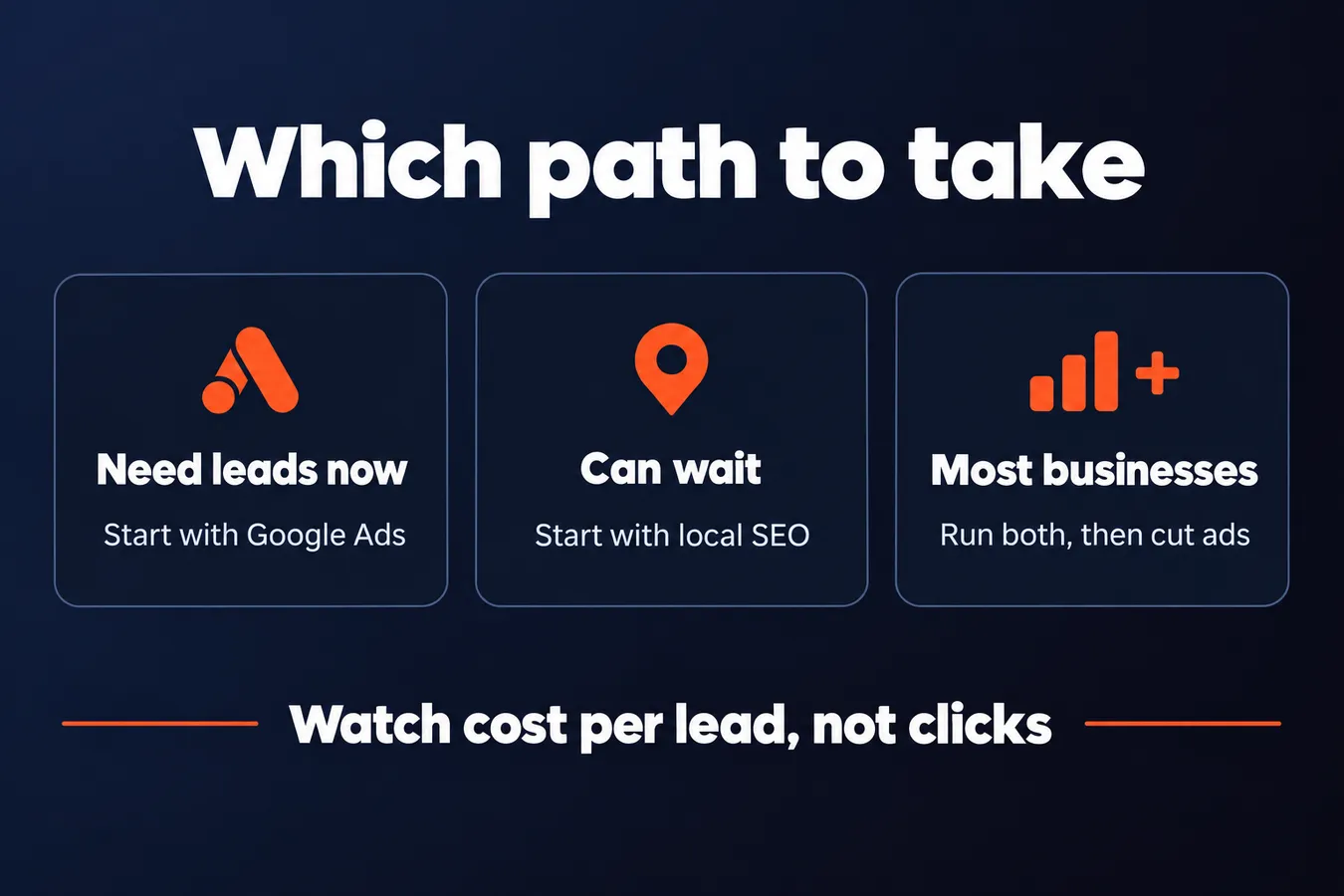
Here's the decision rule. Pick the option that matches your situation right now, even if another one sounds better in the abstract.
Choose Google Ads first if you need leads now.
That means you have a clear budget, you can afford to pay for each click or call while you wait, and you can track which calls turn into paying customers. If you can't tell a good lead from a bad one, ads will drain money fast. Start with a small daily budget, watch the search terms, and cut anything that brings in tire-kickers or wrong-area calls.
Ads are the faster lever. You can be showing up in local search within days, and you can turn the budget up or down the same afternoon.
Choose local SEO first if you have time and a steady offer.
Local SEO means getting your Google Business Profile, your location pages and your reviews working so you show up in the map pack and organic results without paying per click. It takes months to build, so it only makes sense if you can wait. If you have a service people need all year and you want the lowest cost per lead over the next year or two, this is where the money goes.
It's slower to start and it doesn't turn off when you stop paying. That's the whole appeal.
For most local businesses, the answer is both.
Run ads for the next few weeks and months so the phone keeps ringing. Build local SEO alongside them so that, over time, more of your leads come from search that costs you nothing per click. As the organic traffic grows, you can shrink the ad spend bit by bit.
That's the plan I'd recommend to most people. Ads pay the bills while the search presence builds, and you cut them back when you don't need them anymore.
Watch the cost per lead.
A cheap click that never picks up the phone is wasted money. A pricey click from someone ready to book is a bargain. Whichever route you take, judge it by what it costs to get a customer, and check that figure against the dashboard numbers rather than trusting how the dashboard looks.
If you want the details on how each one works, the pages on Google Maps Ads and Google Local Service Ads in this hub go deeper on setup and pricing.
Frequently asked questions
Can Google Ads help with SEO?
Not directly. Paying for ads doesn't move your organic rankings or your spot in the map pack. What ads can do is bring in leads while your local SEO work builds up, which is why many businesses run both for a while. When the ads are running, you can also see which search terms bring real calls, and that tells you what to focus on in your organic pages.
Can I do SEO on my own?
Yes, for local SEO the basics are within reach if you're willing to put in the time. Keep your Google Business Profile accurate, add photos, ask happy customers for reviews, and make sure your name, address and phone number match across directories. It's slow work, and you'll need to keep at it, but none of it requires paying anyone per click.
What's the difference between SEO and local SEO?
Regular SEO aims to rank your website for searches across a wider area. Local SEO focuses on people searching near them, so it leans on your Google Business Profile, your location pages and your reviews. The map pack, the three-business block at the top of local results, is the main prize. For a service business that serves one town or region, local SEO is usually the part that brings in the calls.
Aha Studio
Get the next playbook first
New playbooks and LaunchWatch reports land in Growth Signals, the free newsletter, along with the case studies and how-tos I find worth stealing.
More in Paid Local Visibility
- Google Maps Ads: How They Work and What They Cost
- Google Local Service Ads for Home Service Businesses: Setup, Verification and Lead Handling
Explore the full Local SEO and Google Business Visibility hub