New from Anthony Hayes: Aha Studio
Get found by the people searching for what you sell.
Local SEO and Google Business Visibility › Build Local Landing Pages and Visibility
Local link building
Local link building is about getting the sites and organisations near you to link to you, and that is usually cheaper and easier than cold outreach to national blogs. This post walks through 13 local sources worth chasing, grouped by where they come from, and how to judge whether a link building company actually knows how to get them.
Most of the link building companies ranking for this search sell the same thing: a spreadsheet of blogs they can pitch.
Some of those blogs are good. Plenty of them are hard to reach, expensive, or only loosely related to the business that's paying for the link.
Local sources are usually sitting closer to home, and they're often far easier to get.
Your chamber of commerce, the local paper, the youth league you already sponsor, the council that runs the event down the road. These organisations already have websites, already list their members and partners, and already want to show their community is active.
That's the gap. Most link building companies go after the biggest names they can find, and the local ones get overlooked.
I've been building marketing software since 2011, and local linking is the part I keep coming back to. The links that tend to hold up are the ones tied to a real relationship: a sponsorship, a membership, a story someone actually wanted to write.
Here's what's coming. We'll go through 13 ways to earn local links, grouped into five areas: local organisations that already link to businesses like yours, local media and news, sponsorships and community involvement, local content and partnerships, and how to judge a link building company that says it can do the local work.
You don't need a big budget for most of these. You do need to know where to look, and which ones are worth your time.
Find this useful? Add us as a preferred source on Google and more of what we publish will show up in your results.
Local organisations that already link to businesses like yours
1. Ask the chamber of commerce for a member listing link
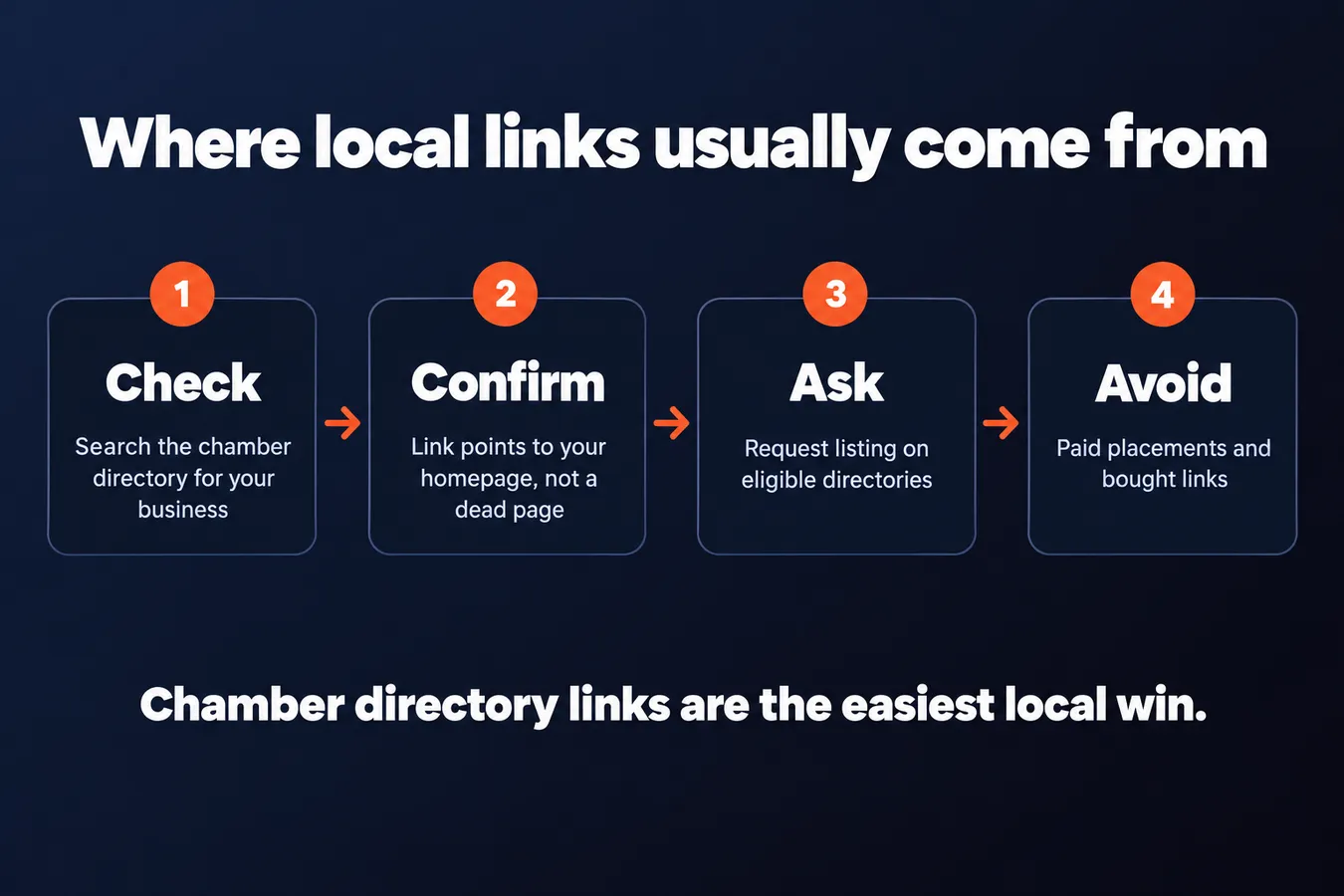
Most chambers of commerce run a member directory, and most of those directories link out to each business's website. For a local business, that's one of the most reliable links you can get, because the chamber is a local body that vouches for you by listing you at all.
Check whether you're already listed before you spend anything. Membership usually costs a modest annual fee, so if you're a paying member, your listing may be sitting there with a link you've never looked for. Search the directory for your business name, and check that the link points to your homepage and not to a dead page.
If you're not a member and you're thinking about joining, ask a link building company whether they can get you listed on a chamber directory you're eligible for. A good provider will explain what the directory costs and what you'll get. Be wary of anyone who offers to pay for your placement or sell you a spot in a directory. That's a red flag, and the link is worth very little if it's bought.
Chamber directory links are the easiest local win, so start here.
2. Get listed in local trade associations and industry directories
Think about the trade bodies your customers already trust. Plumbing guilds, dental associations, realtor boards and similar groups often have city or regional chapters, and most of them maintain a member directory with links to each firm.
These links do two jobs at once. They're local, because the chapter covers your area, and they're topical, because the association is about your trade. Search engines tend to value that combination, and it's the kind of link a competitor who only does generic outreach rarely gets.
Ask any provider how they find these associations, and whether they check that each one is still active before pitching. A chapter that folded two years ago gives you nothing. A good provider will show you the list of bodies they're targeting and explain why each one fits.
3. Pursue Business Improvement District and local council listings
Some councils and business improvement districts (BIDs) list local businesses on their websites, particularly in town centres and shopping areas. Most agencies never mention these sites, and most link sellers don't sell them, because they're hard to get and can't be bought in bulk.
Eligibility varies a lot by town. In some places the BID lists every member business, and in others it only lists event partners or sponsors. Ask the provider which municipal sites they have actually earned links from, and which ones they only expect to reach.
A provider who brings up BID and council listings without being asked is probably doing real research on your local area. That's the kind of work worth paying for.
Local media and news coverage
4. Pitch local newspapers and news sites with a real local story
Local news is one of the strongest link sources you can get, but only if the pitch is actually newsworthy. A local editor has a few hundred things competing for a few slots, and they're not going to run your product announcement because you asked nicely.
What works is a story about something happening in their town. A new hire at your company, an expansion that means new jobs, a community project you're running, or a local survey you've done that shows something interesting about the area. Those are the kinds of things editors say yes to.
A pitch that reads like an ad gets ignored. If the email is mostly about how great your business is, the editor will delete it in about four seconds. I've seen plenty of these, and the ones that go nowhere almost always lead with the company instead of the news.
When you're comparing link building companies, ask them two things. How many local news pitches do they send per month? And what happens to the ones that don't land? If the answer to the second question is "we move on," that's a red flag. A good provider should be able to tell you why a pitch failed and what they'd change next time. Otherwise you're paying for volume, and volume is cheap.
5. Offer local reporters a source for stories in your field
This is the approach I'd put the most faith in over the long run. Instead of pitching a story, you make yourself the person reporters call when they need someone who knows a topic.
Local reporters constantly need a quick comment from someone who understands things like home repairs, tax deadlines, or traffic changes. If you run a plumbing business, you're the obvious person for a story about frozen pipes. If you're an accountant, you're the one they call before the filing date. Each time you're quoted, the story usually links back to your site.
Services that connect experts with journalists exist, and some link building companies offer them as part of a package. Ask whether that's included and how they match you to reporters. (Just make sure the source they're using is one you'd actually want your name attached to.)
Be honest about whether you can respond fast enough. Most of these requests come with a deadline of a few hours, sometimes less. If you're in meetings all afternoon or you can't reply until the next morning, the reporter will simply quote someone else. Speed matters more here than polish, so a quick, accurate two-sentence answer beats a perfect one that arrives after the story has run.
Sponsorships and community involvement
6. Sponsor a local team, event or charity and get the link
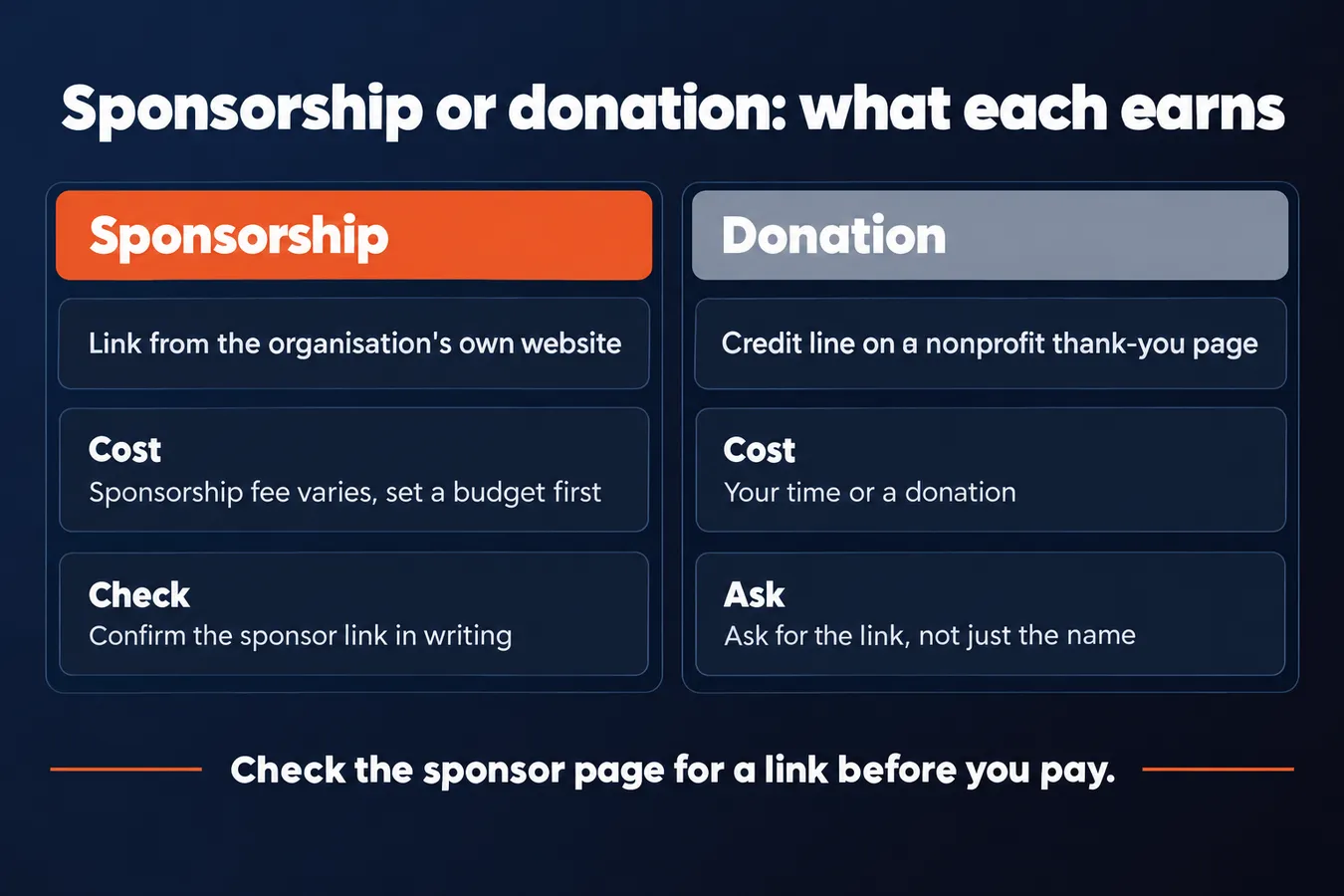
Youth sports leagues, school events, charity runs and local festivals often list their sponsors on a page with a link back to each one. That link is usually coming from the organisation's own website, which is one of the most overlooked local links you can get.
Sponsorship costs vary a lot. A small donation might get your name in a program, while a banner at a charity run can run to a few hundred dollars. Set a budget before you talk to anyone, so you don't end up agreeing to a package you can't afford.
Check the sponsor page for a link before you pay.
Some organisations list sponsors by name without linking to them, and that's a very different deal. Ask directly whether the sponsor listing includes a link to your site, and get the answer in writing. A link building company can help you find the right events, but you should confirm the link yourself before the money changes hands.
7. Volunteer or donate and ask for a credit line with a link
If sponsorship is more than you want to spend, volunteering or donating is a cheaper way in that can still earn a link. Many local nonprofits thank donors and volunteers on a page with a website link, and that page tends to stay up for years.
This works best when the involvement is real. A nonprofit that knows you and your work is far more likely to link to you than one that only received a cheque from a company it has never heard of.
Ask for the credit line, and ask for the link.
Don't assume the thank-you page will include a link just because you helped. Ask the volunteer coordinator or development person whether your business name can appear with your website, and when you're asked, say yes.
A link building company can help you spot these opportunities, but the relationship has to be yours. I've seen the best results come from people who show up to the events themselves, since the links tend to follow the relationships.
Local link sources compared
| Source | Who links | Main cost or effort |
|---|---|---|
| Sponsored team, event or charity | Organisation's own website | Sponsorship fee, amount varies |
| Volunteering or donating | Nonprofit thank-you page | Your time or a donation |
| Co-hosted local event | Event pages and partner sites | Shared planning, written agreement |
| Reciprocal links with local firms | Partner's resource or recommendations page | Mutual agreement, low cost |
Local content and partnerships
8. Co-host a local event with a business that already has a strong site
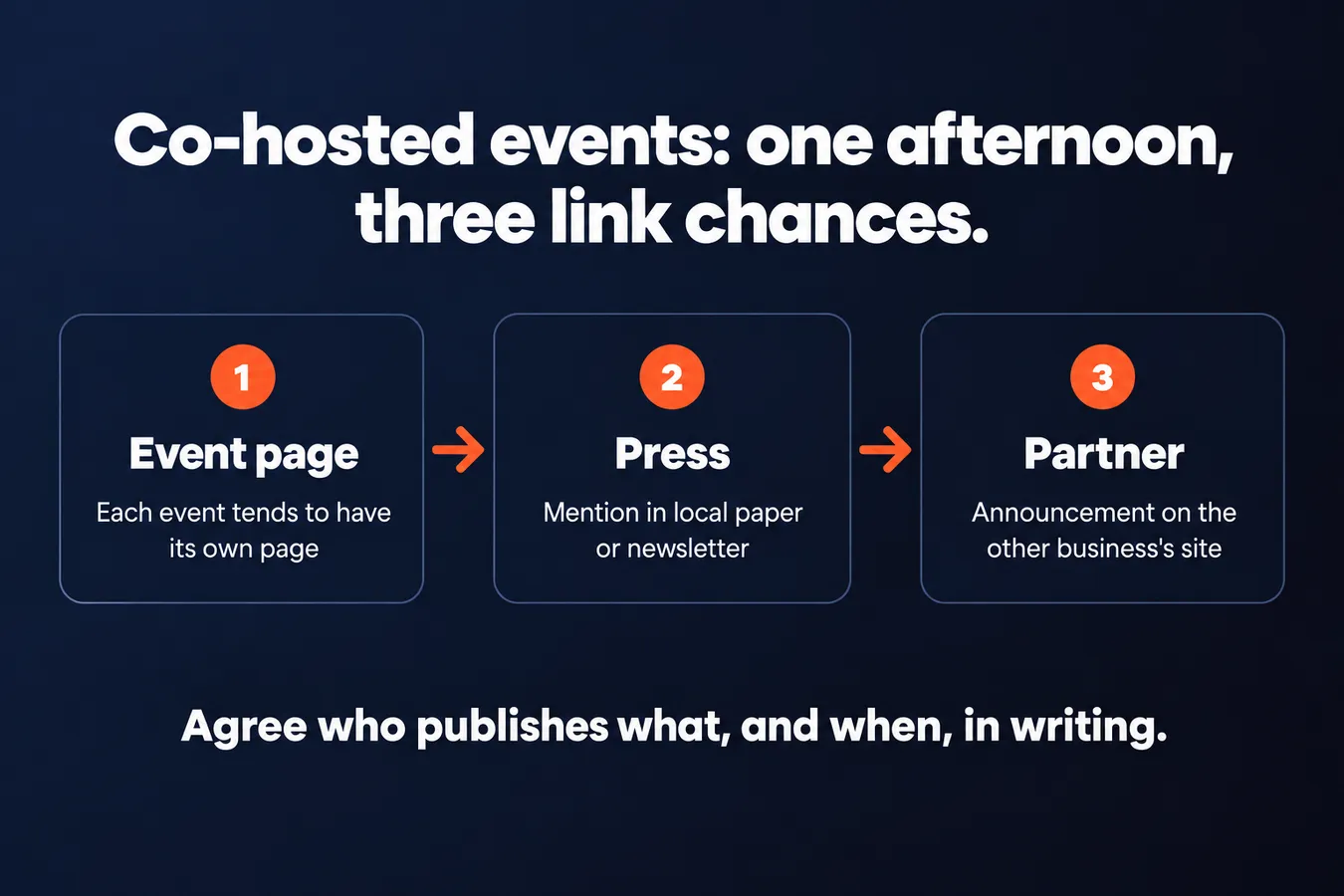
Workshops, open days and networking evenings are easy links to earn. Each event tends to produce its own event page, a press mention in the local paper or newsletter, and a partner announcement on the other business's site. That's three places a link can land from one afternoon of work.
Pick partners carefully. A big name with a dead website gives you very little, and the value of a link depends on the site that gives it. A busy, local business with a site that gets updated regularly is worth far more than a national brand that never mentions its own events.
Agree in writing who will publish what, and when. Verbal promises tend to evaporate once the event is over. Put it in an email: who writes the event page, who posts the announcement, and who includes the link. That's the only way you'll know the link actually got placed.
9. Publish a local guide or resource that other sites will cite
A useful local resource earns links on its own, provided people in the area actually need it. Think a guide to local permits, a list of nearby services, or a short survey of residents on a local issue. The test is simple: would a local school, blogger or community site point their readers to it?
The likely linkers are local bloggers, schools, parish newsletters and community sites. Don't wait for them to find it. You'll usually need to contact a few of them directly and say why the page is useful to their readers.
I think this is the only option on the list that compounds over time. A good guide keeps getting found and linked long after the first push, while an event link is a one-off. That's why I'd put real effort into one solid resource before doing a dozen small things.
10. Swap links with local businesses that serve the same customers
Reciprocal links work best between businesses that serve the same people without competing. A florist and a wedding photographer, or a roofer and a gutter company, are good examples. Each can link to the other from a resource or recommendations page where the link makes sense to a visitor.
The rule is simple. Only link to a partner if the link would help a real visitor, or it's not worth having. If you can't explain to a customer why the link is there, leave it out.
Be wary of mass link exchanges with unrelated sites. Those are a different thing entirely, and a provider who proposes them is not doing local work. Real local link building is slower, but the links carry weight because they make sense to the people reading them.
Judging a link building company for local work
11. Ask which local sources the company has earned links from before
Most link building companies will show you a list of links they've built. The useful question is where those links came from. A provider that only shows national guest posts on general blogs is probably not set up for local SEO, because local links come from places like chambers of commerce, local newspapers, neighborhood associations and sponsored events. Ask for examples that include the city or region, and then check a few of them yourself.
Open the link in a browser. Does the page actually exist, is it live, and does it mention your area? Is the site a real local publication or a directory that takes anyone who pays? Five minutes of clicking will tell you more than the sales deck.
Ask how they handle sponsorships and paid placements too. Sponsoring a local 5K or a youth league is a legitimate way to earn a local link, but the sponsorship should be clearly marked as sponsored. If a company buys placements and hides that from you, expect that same vagueness to show up in other parts of the work.
12. Check the contract for link types, reporting and what you own
The contract is where the real answers sit. A flashy monthly price means nothing if you can't see what you're paying for. Start by asking for a list of every link built each month, with the URL, the page it sits on and the anchor text used. If the report is a screenshot or a total count, push for the full list.
Ask what happens when a link disappears. Sites get redesigned, pages get deleted, and local publications close. Confirm whether the provider will replace a link that's removed, and get that promise written down.
Also check who owns the relationships. The contacts a provider makes for you at a local paper or trade association are valuable. Make sure they stay available to you if you end the contract, rather than walking out the door with the people you were paying for.
13. Start with three local links this month and measure them
You don't need to hire anyone to start. Pick three sources from this list: your local chamber of commerce directory, a trade association you belong to, and one pitch to a local news outlet about something real happening at your business.
Then track whether each one brings referral visitors or local search impressions. Use the same tracking you already use for rankings, so you're comparing like with like. Give each source enough time to show something before you judge it. Your local listings and the pages you're linking to are worth tracking alongside, which is covered in How to Track Local SEO Results.
Once you know which sources actually work for your business, you'll be a much better judge of any link building company you talk to. You'll know what a good local link looks like, and you'll spot a sales pitch built on national guest posts from across the room.
Frequently asked questions
How do I check whether my business is already listed on my chamber of commerce directory?
Search the chamber's member directory for your business name before you spend anything. If you're a paying member, your listing may already be there with a link you've never looked for. Check that the link points to your homepage and not to a dead page, and fix it with the chamber if it doesn't.
How do I pitch a local news story without it getting ignored?
Pitch something happening in the editor's town, like a new hire, an expansion that means jobs, a community project, or a local survey with an interesting finding. A pitch that reads like an ad gets deleted fast, so lead with the news.
What should I ask a link building company about local work before I hire one?
Ask for examples of links they've built in your city or region, and skip the national guest posts on general blogs. Then open a few of the links yourself to confirm the page is live, mentions your area, and sits on a real local publication. Ask too how they handle sponsorships and whether each one is clearly marked as sponsored.
What happens if a local link disappears after it's been placed?
Sites get redesigned, pages get deleted, and local publications close, so links can vanish. Ask the provider whether they'll replace a removed link, and get that promise in writing. Also confirm who owns the contacts they make for you at local papers and trade associations, so you keep those relationships if you end the contract.
Aha Studio
Get the next playbook first
New playbooks and LaunchWatch reports land in Growth Signals, the free newsletter, along with the case studies and how-tos I find worth stealing.
More in Build Local Landing Pages and Visibility
- Location Pages That Rank for Local Searches: How to Build a Unique Page per City or Neighborhood Without Creating Thin D
- How to Track Local SEO Results: The Google Business Profile Metrics That Matter
Explore the full Local SEO and Google Business Visibility hub