New from Anthony Hayes: Aha Studio
Get found by the people searching for what you sell.
Build in Public · #6
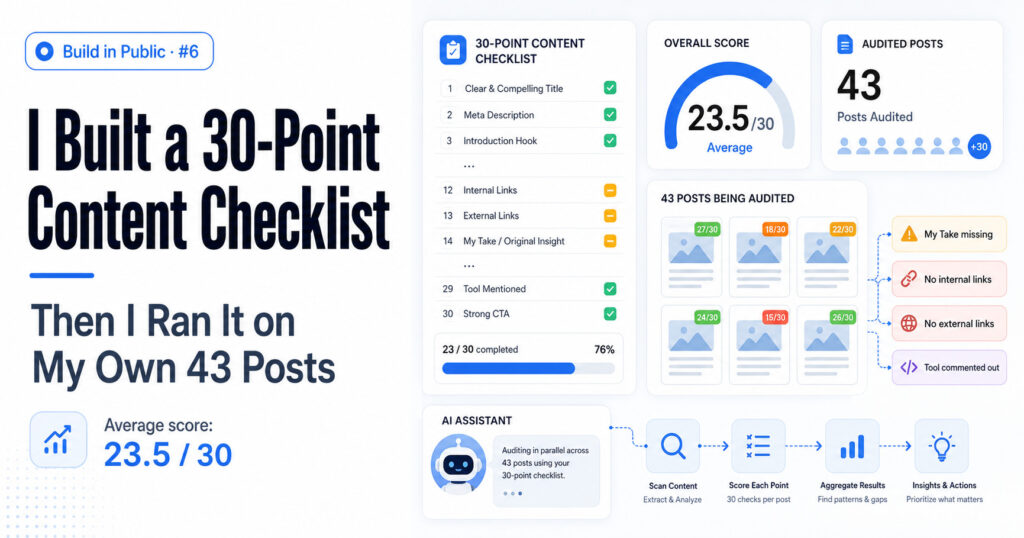
Everybody publishes a “here’s my SEO checklist” post. Almost nobody runs their own checklist against their own content. So I did, on all 43 posts on this site, and it was a humbling afternoon. Here’s what building your asset site with Claude looks like when you actually hold yourself to your own standard.
There’s a special kind of marketer who writes 2,000 words on “the 24 things you must do before publishing,” then hits publish without doing half of them. For a while, that marketer was me. Here’s how I found out, and what I did about it in one afternoon, with Claude.
Find this useful? Add us as a preferred source on Google and more of what we publish will show up in your results.
What “do as we say we do” actually means
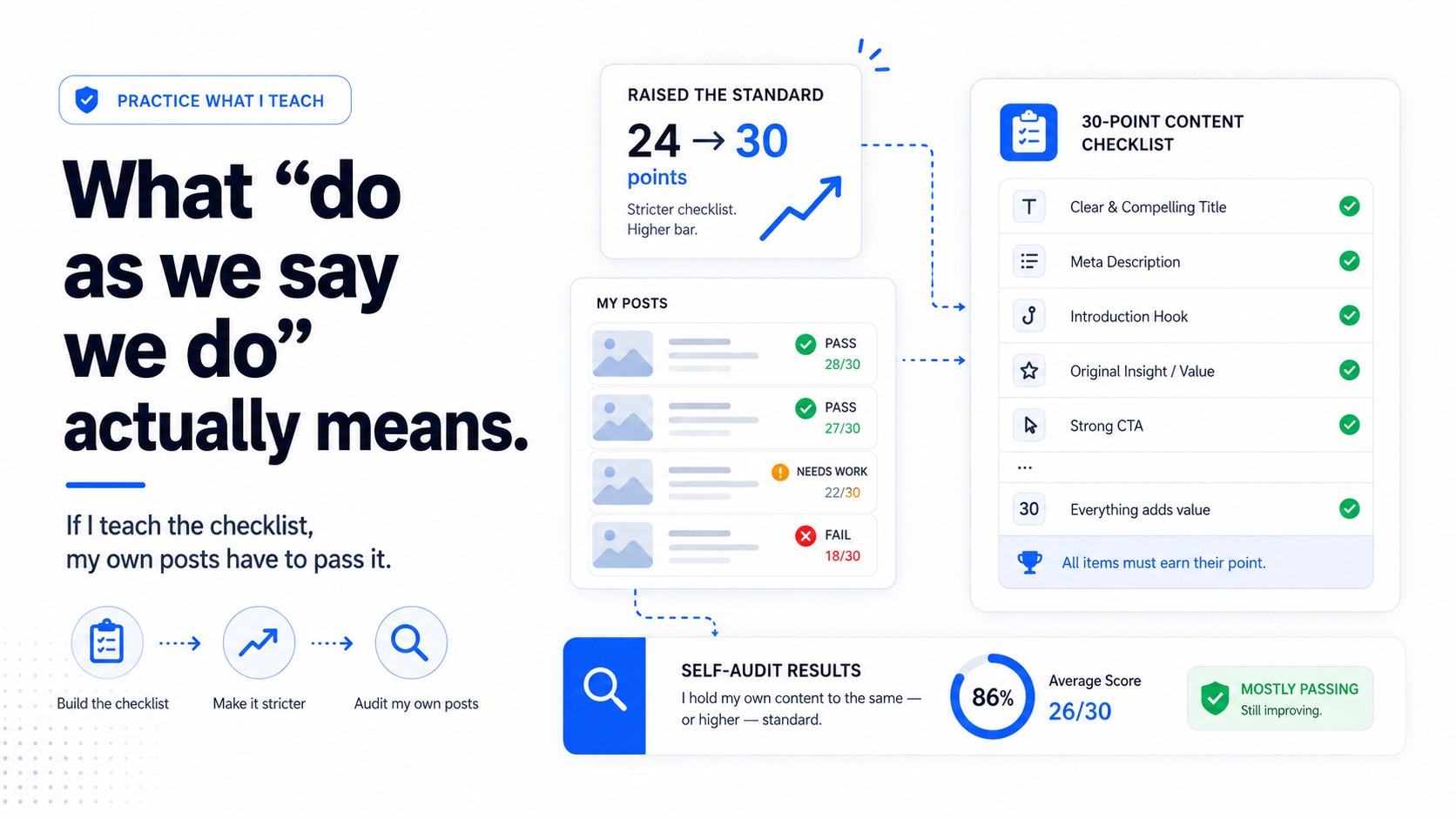
It’s simple: if I’m going to teach a checklist, my own posts had better pass it. Not “mostly.” Pass it. Anything less and I’m just another guru selling advice I don’t follow. So this week I did the two things most people skip: I made my checklist harder, then I turned it on myself.
First, I made the checklist harder
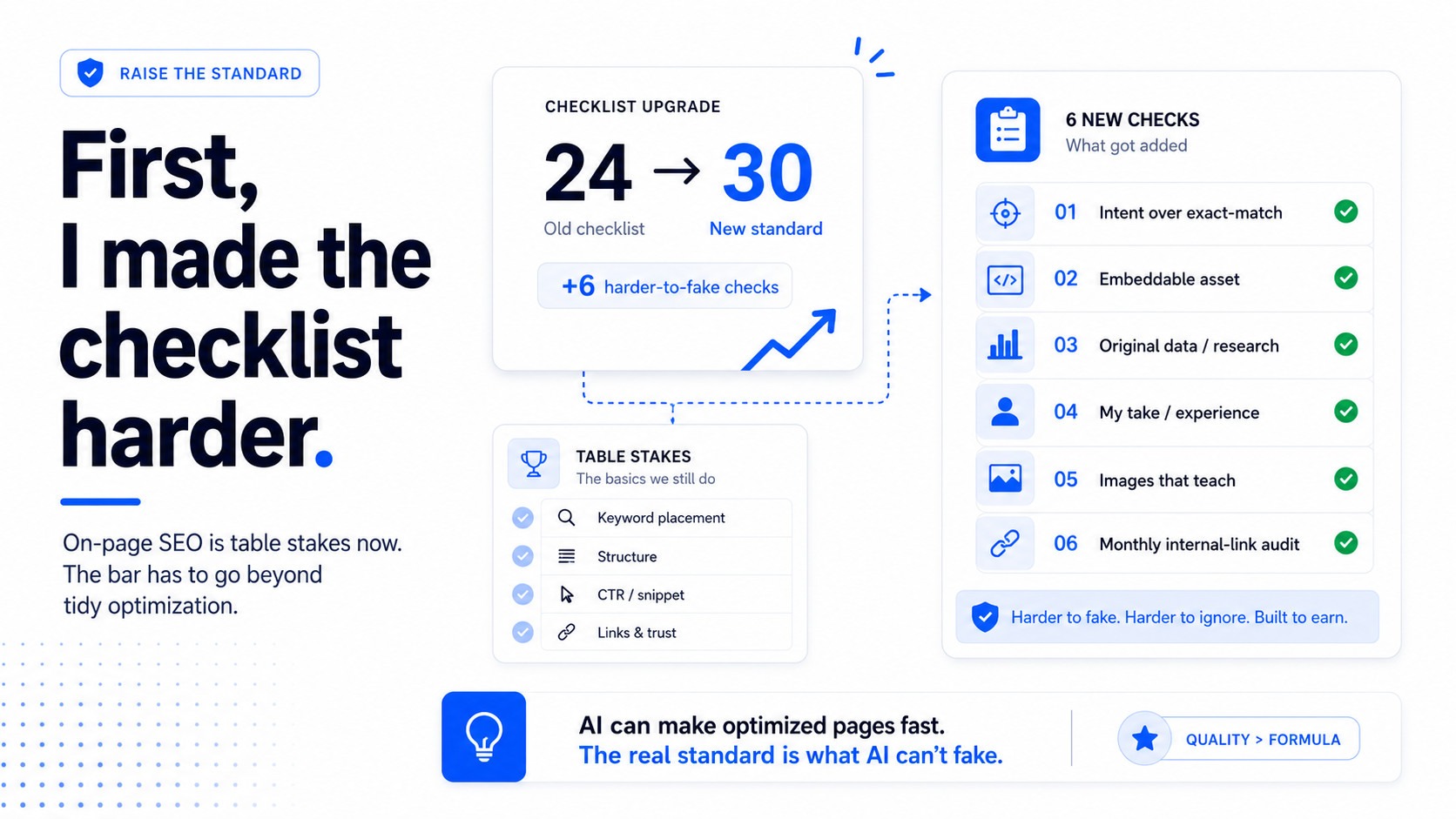
My on-page checklist used to be 24 points: keyword placement, structure, click-through, snippet readiness, links and trust. All still true. But on-page is table stakes now. With AI, anyone can produce a tidy, optimized page in minutes. So the checklist can’t stop at where the keyword goes.
I added six checks that are genuinely hard to fake, and pushed it to 30:
- Intent over exact-match. SEO plugins mark you down for not repeating the exact keyword everywhere. Google stopped working that way years ago, the same reason Google Ads killed phrase match: it understands intent.
- A linkable, embeddable asset in the post: a tool or interactive checklist others can embed and link back to.
- Original data or research where the topic allows (easy now with AI, if you verify it).
- Your own take or experience, the one thing AI can’t generate for you.
- Images that teach, the way Brian Dean does on Backlinko: diagrams and screenshots, not decorative stock.
- Internal links as a living job, re-audited monthly, because every new post changes what should link where.
You can run the whole thing yourself, it’s embedded right here:
Then I ran it on all 43 of my own posts
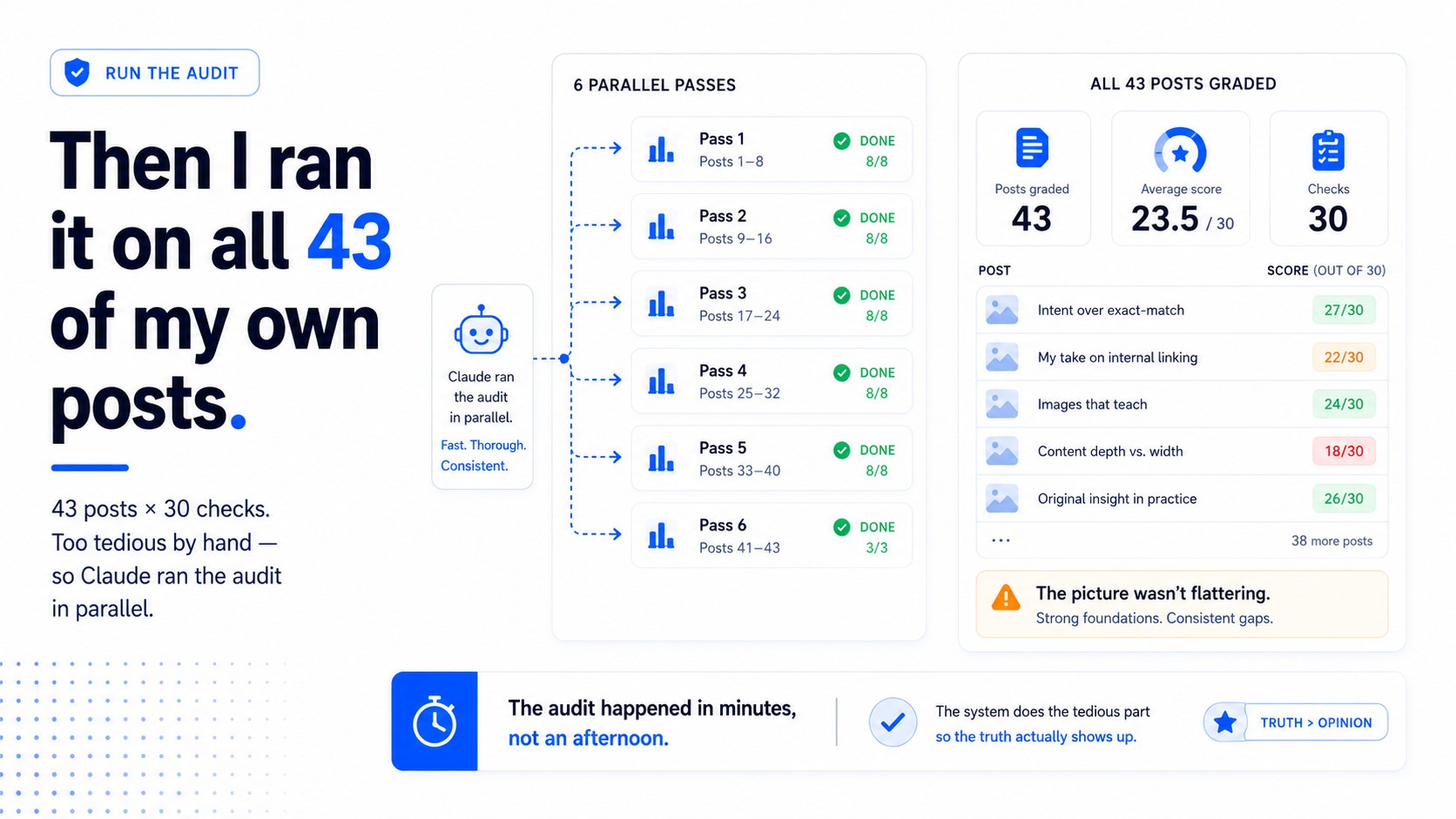
Grading 43 posts by hand against 30 checks each is exactly the kind of tedious job that never happens. So I didn’t do it by hand. I had Claude fan out: six passes running in parallel, each pulling a batch of posts, reading the content and the Rank Math data, and scoring every one against the 30 points. A few minutes later I had every post graded. The picture wasn’t flattering.
What it found (the uncomfortable part)
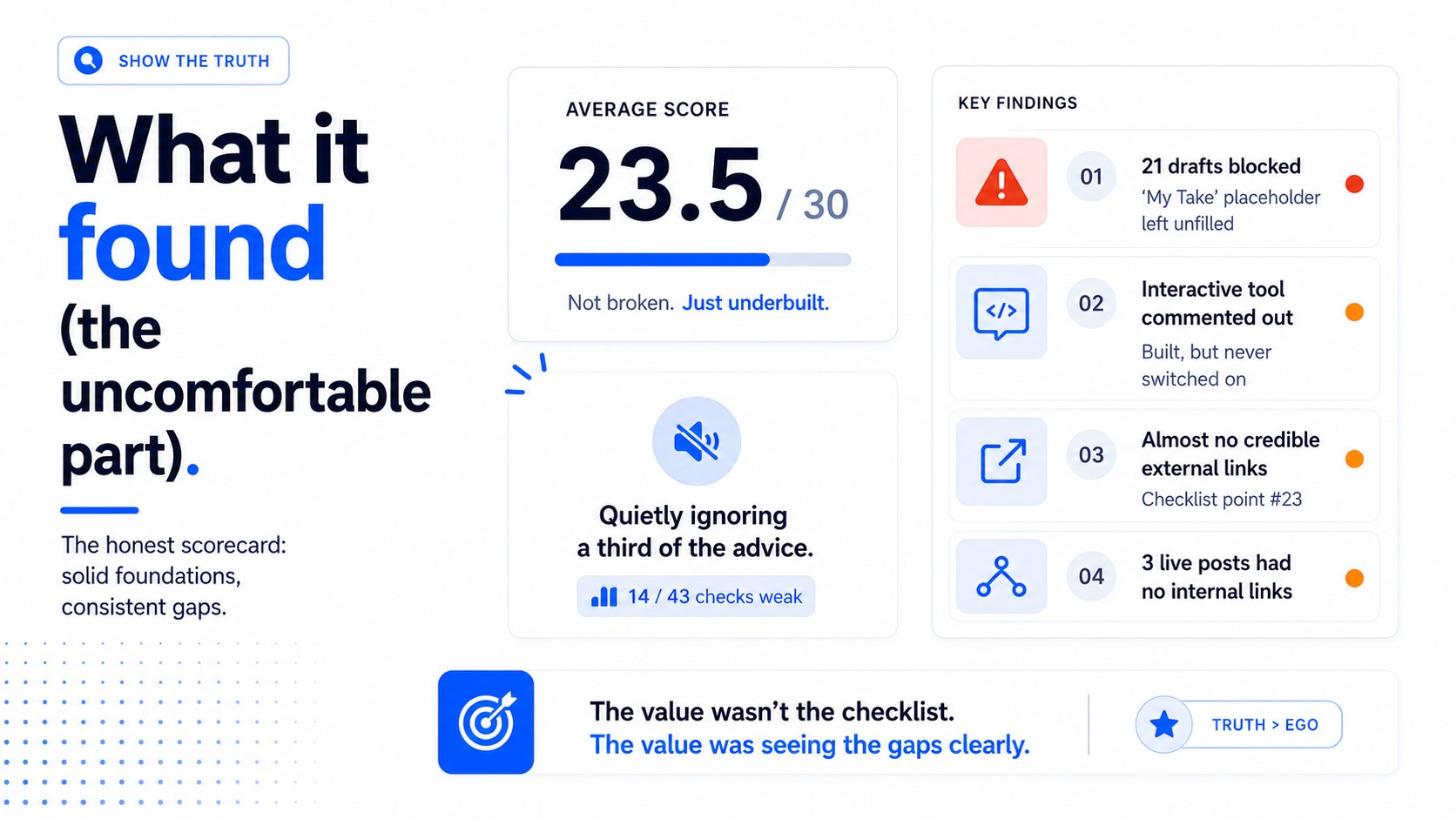
- Average score: 23.5 out of 30. Solid foundations, consistent gaps.
- 21 drafts were blocked by one thing: an unfilled “My Take” placeholder. I’d built a system to remind me to add my own opinion to every post, then left the reminder sitting there, unfilled, twenty-one times.
- A cluster of posts had their interactive tool sitting in the code as an HTML comment, built, but never switched on.
- Almost none of my posts had a single credible external link. My own checklist point #23. Whoops.
- My three live posts had no internal links at all.
That’s the honest scorecard. I teach this stuff, and my own site was quietly ignoring a third of the advice. (If you want proof I show the real numbers even when they’re unflattering, I’ve done it before.)
The fix isn’t willpower. It’s a system.
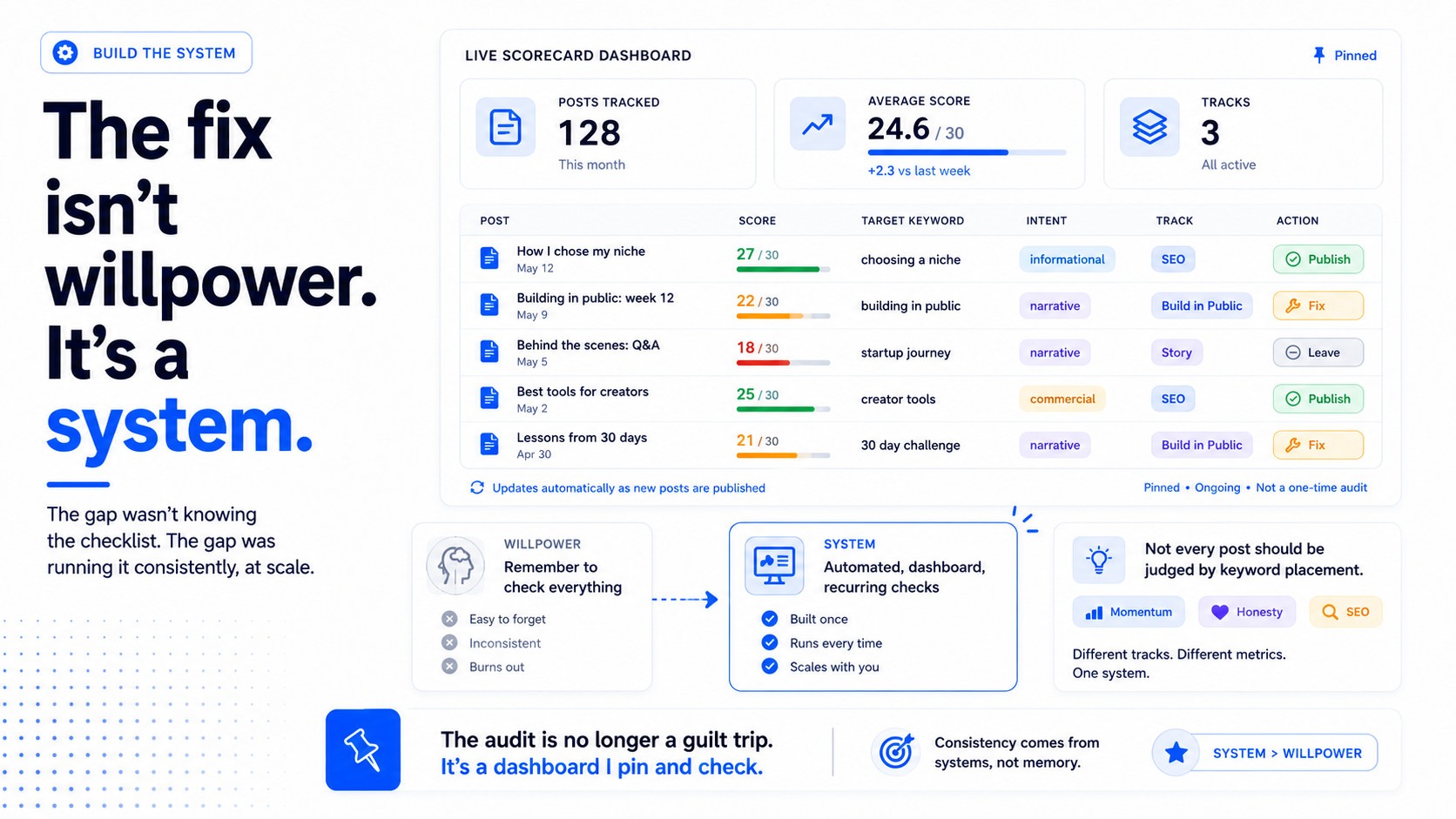
Here’s what I want you to take from this: the gap was never knowing the checklist. I wrote the checklist. The gap was running it, consistently, at scale, and you don’t close that with discipline, you close it with a system.
So I built one more thing: a live scorecard dashboard. Every post, its score, its target keyword, its search intent, and its track, because not every post is an SEO post. Some are build-in-public stories like this one, and they should be judged on momentum and honesty, not keyword placement. The dashboard tells me at a glance which posts to fix, which to publish, and which to leave alone as part of the story. Now the audit isn’t a one-time guilt trip. It’s a dashboard I pin and check.
Why this matters if you’re building an asset site
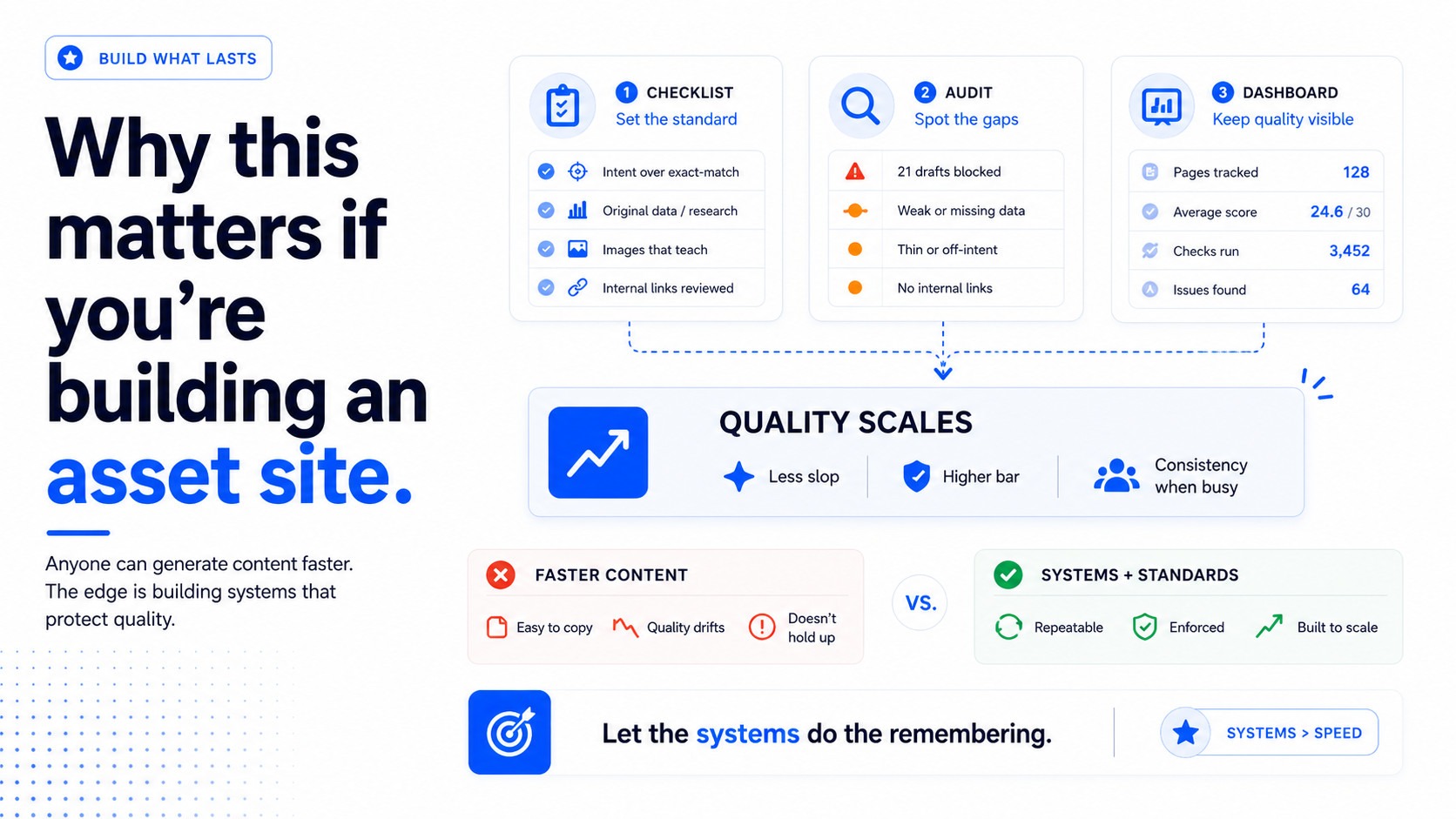
This is what working with Claude to build your main asset site actually looks like. It isn’t “generate content faster”, anyone can do that, and the internet is drowning in the results. It’s building the standard and the systems that enforce it (the checklist, the audit, the dashboard) so quality scales instead of collapsing the moment you get busy. That’s the whole game now: produce less slop, hold a real bar, and let the systems do the remembering.
My Take: Most “expert” content advice is written by people who don’t follow it, not because they’re lying, but because following it by hand is genuinely tedious, so it quietly doesn’t happen. The unlock isn’t more willpower or a better checklist. It’s turning the checklist into a tool that scores you, and the audit into a dashboard that never lets you forget. Build the system that makes doing the right thing the easy thing, and “do as we say we do” stops being a slogan and becomes the default.
Cornerstone Workshop
Want to see exactly how this works?
The checklist, the audit, the dashboards: the whole system for building and running your asset site with Claude. That’s the spine of the Cornerstone workshop.