New from Anthony Hayes: Aha Studio
Get found by the people searching for what you sell.
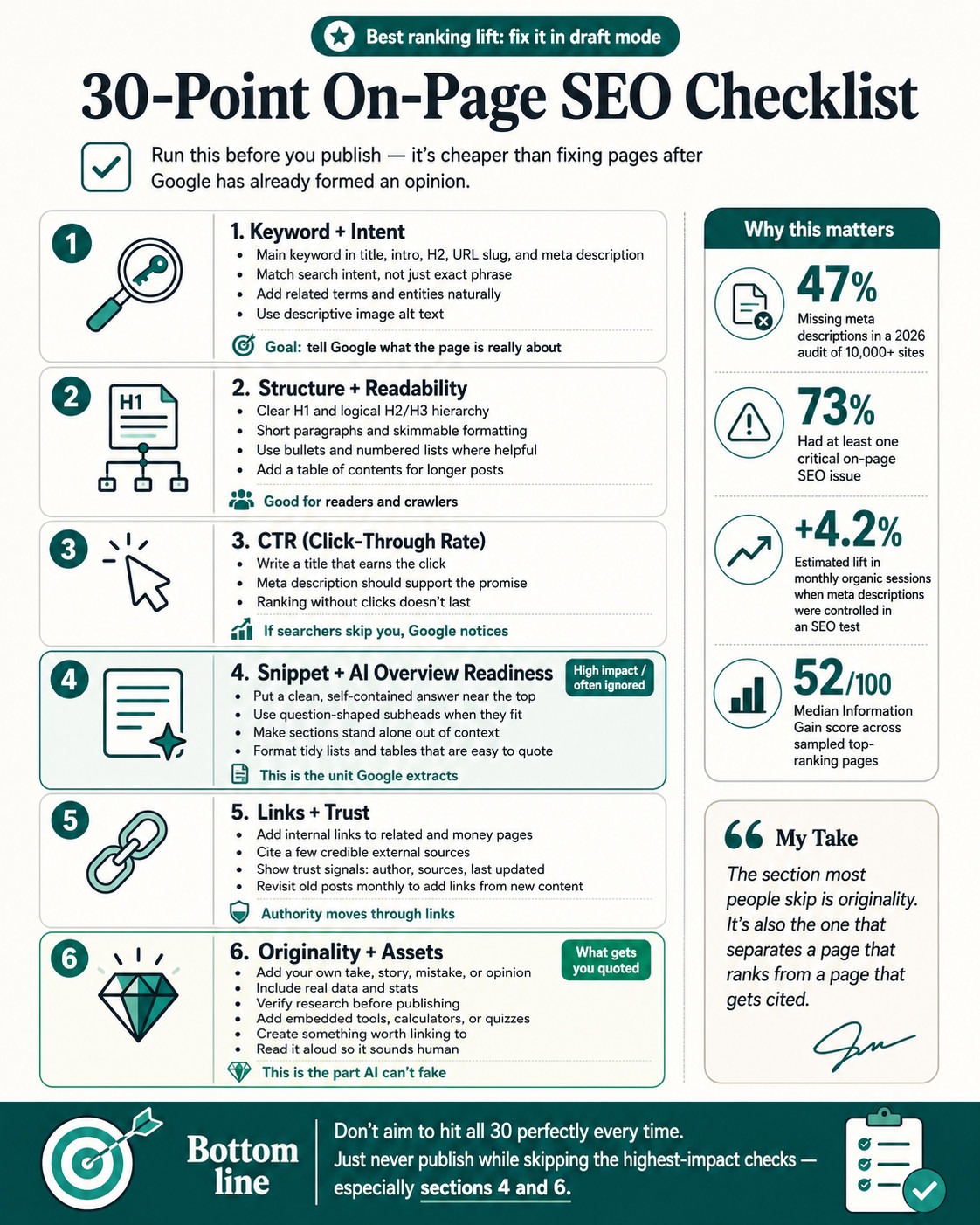
Optimising a page after it’s published is twice the work of doing it before. So I run the same on-page checklist on every post before it goes live. It’s the cheapest ranking lift there is, because you’re fixing things while the page is still a draft, before Google has formed an opinion of it.
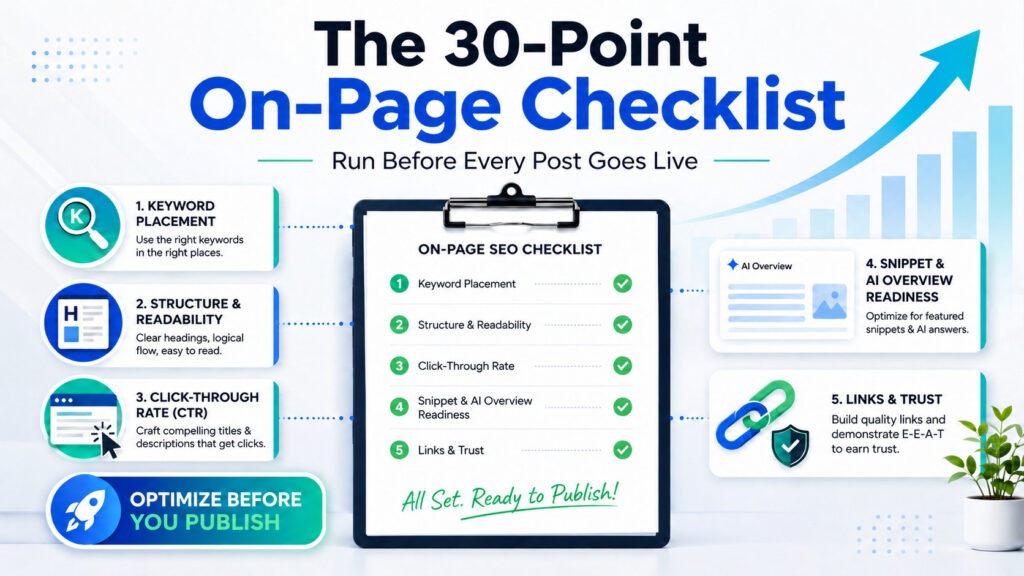
An effective on-page SEO checklist covers 30 points across six areas: keyword and intent, structure and readability, click-through, snippet and AI-Overview readiness, links and trust, and originality. Working through them before you publish, while the page is still a draft, is the cheapest ranking lift there is, because you’re fixing problems before Google forms an opinion of the page.
This list started at 24 points. It’s at 30 now, and the six I added are the ones that separate a page that ranks from a page that gets quoted. Here’s what I actually check. It groups into six areas, and the last two are where most people leave rankings on the table.
Find this useful? Add us as a preferred source on Google and more of what we publish will show up in your results.
1. Keyword and intent
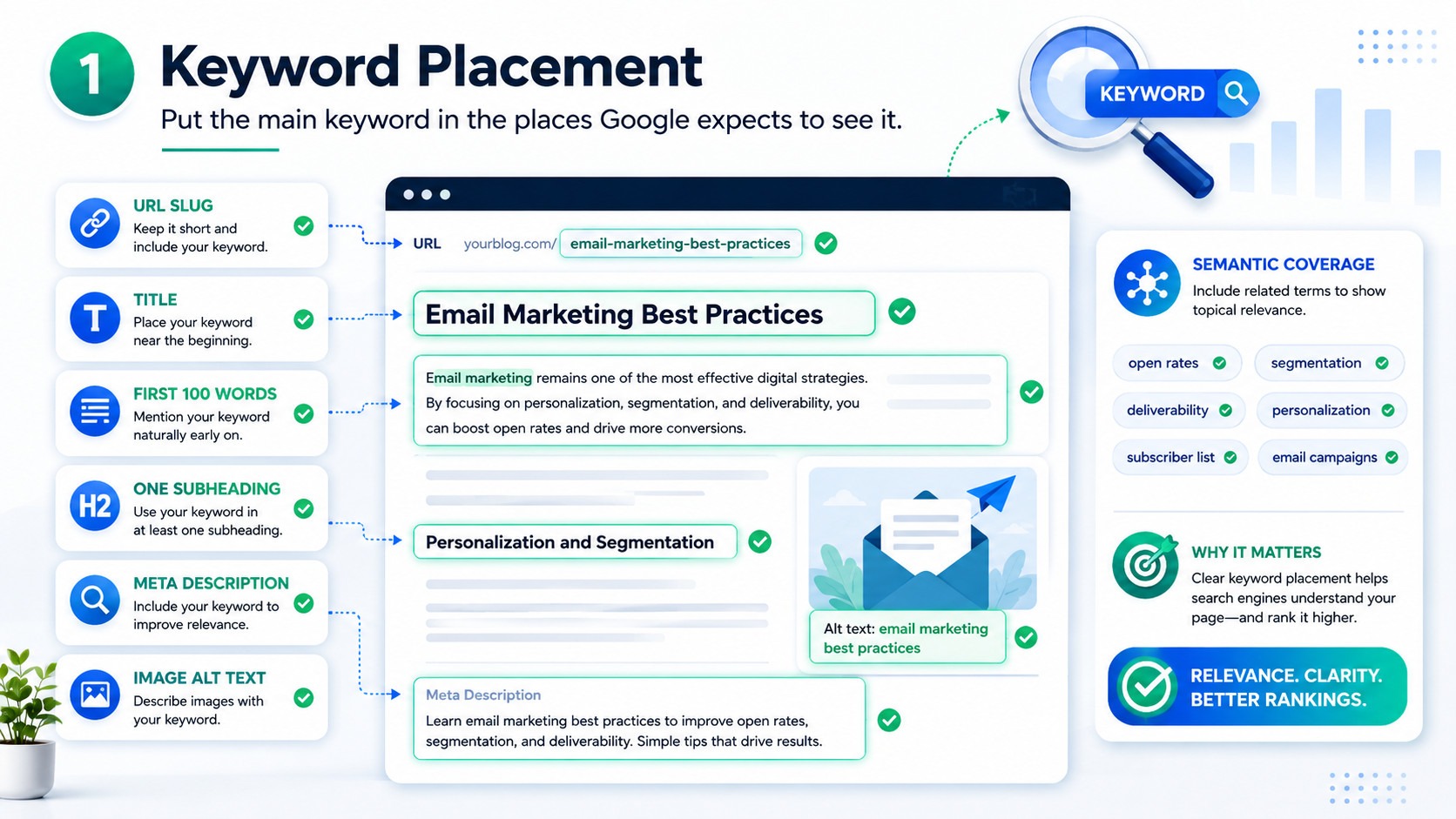
This is how you confirm to Google what the page is about. Get it wrong and even excellent content can rank for the wrong thing, or nothing.
- Main keyword in the title, the first 100 words, at least one subheading, the URL slug, and the meta description.
- Intent match, not exact match. This is the one I’d argue hardest for. Google stopped matching strings with Hummingbird in 2013 and BERT in 2019; it reads meaning now. So the question isn’t “did I repeat the phrase enough”, it’s “does this page deliver what someone searching that phrase actually wants”. A page targeting “SEO software” and a page targeting “SEO definition” are three words apart and serving opposite people.
- Related terms and entities worked in naturally, the words Google expects to see on a page about this topic. Not stuffing; coverage. A page about “email marketing” that never mentions open rates, segmentation or deliverability looks thin to Google, however long it is.
- Image alt text that describes the image and fits the topic.
2. Structure and readability
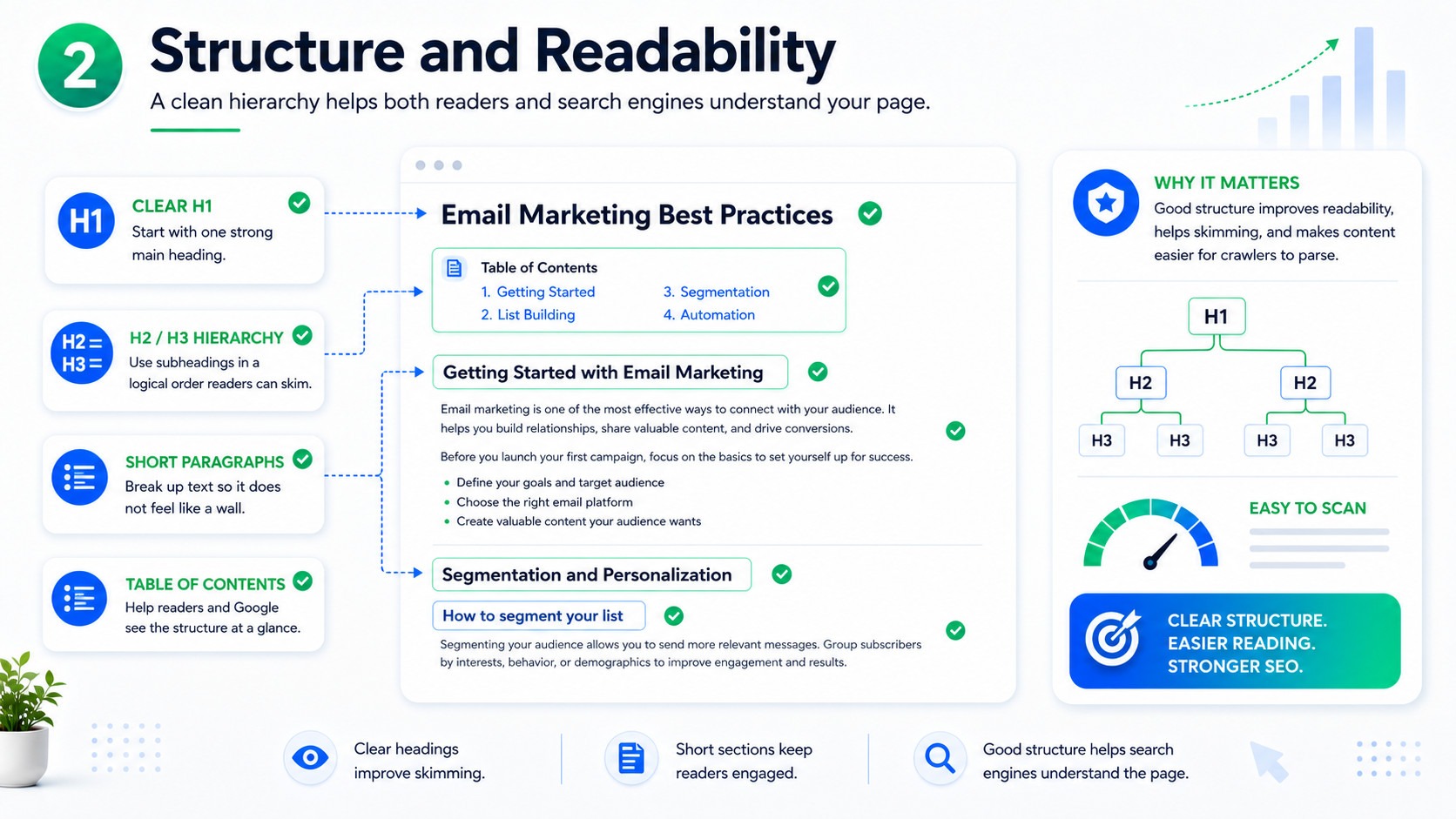
Structure serves two readers at once, the human skimming and the crawler parsing. A clean hierarchy rewards both.
- A clear H1, then a logical H2/H3 hierarchy a reader can skim.
- Short paragraphs, lists where they help, and a real readability pass so it doesn’t read like a wall.
- A table of contents on longer pieces so people (and Google) can see the structure at a glance.
3. Click-through (CTR)
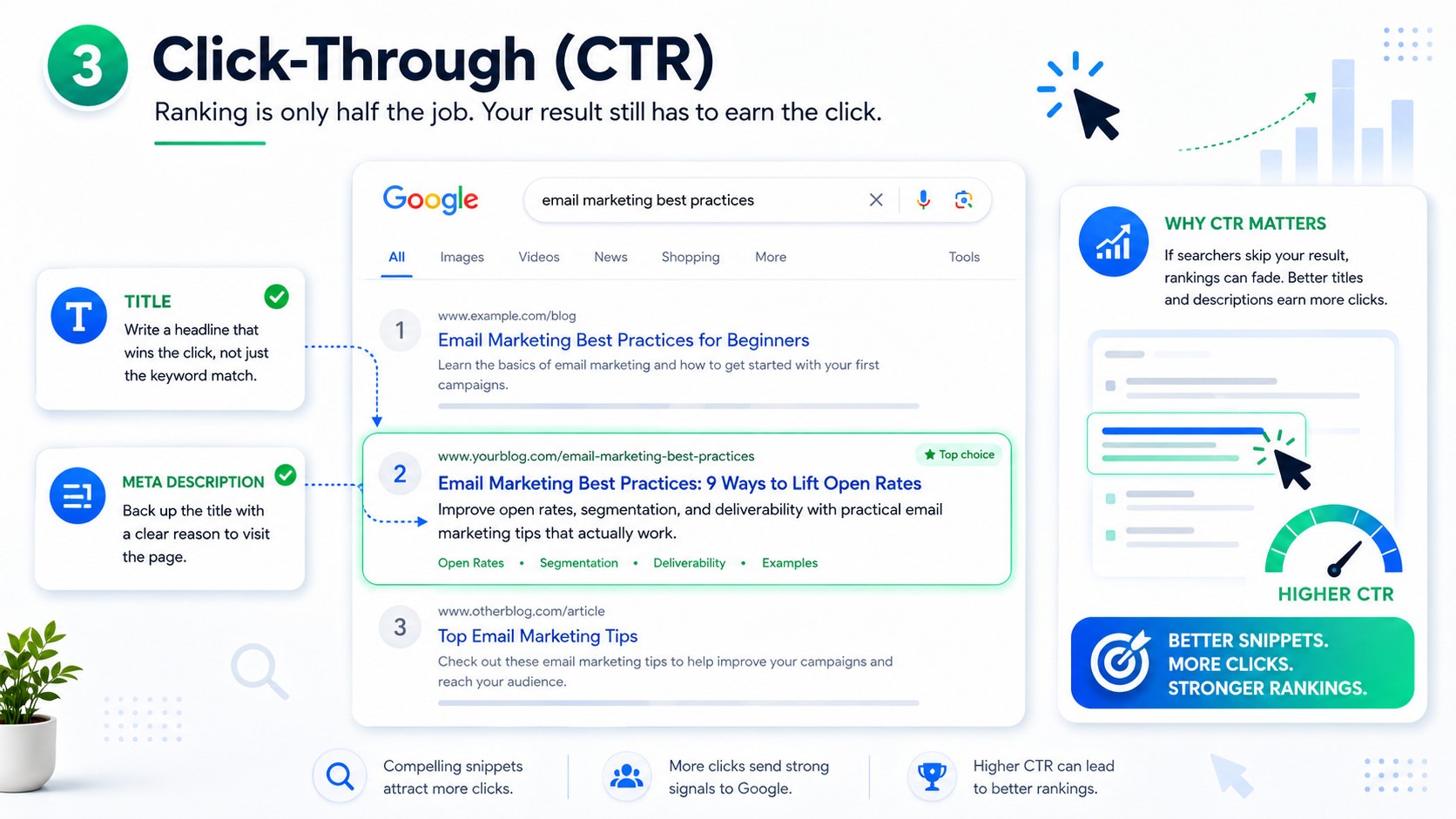
Ranking is only half the job. If the result doesn’t earn the click, the ranking erodes. Google notices when searchers scroll past you to click someone else.
- A title that earns the click in the search result, not just one that contains the keyword.
- A meta description that backs up the title and gives a reason to click. A page that ranks but nobody clicks slides back down.
4. Snippet and AI-Overview readiness
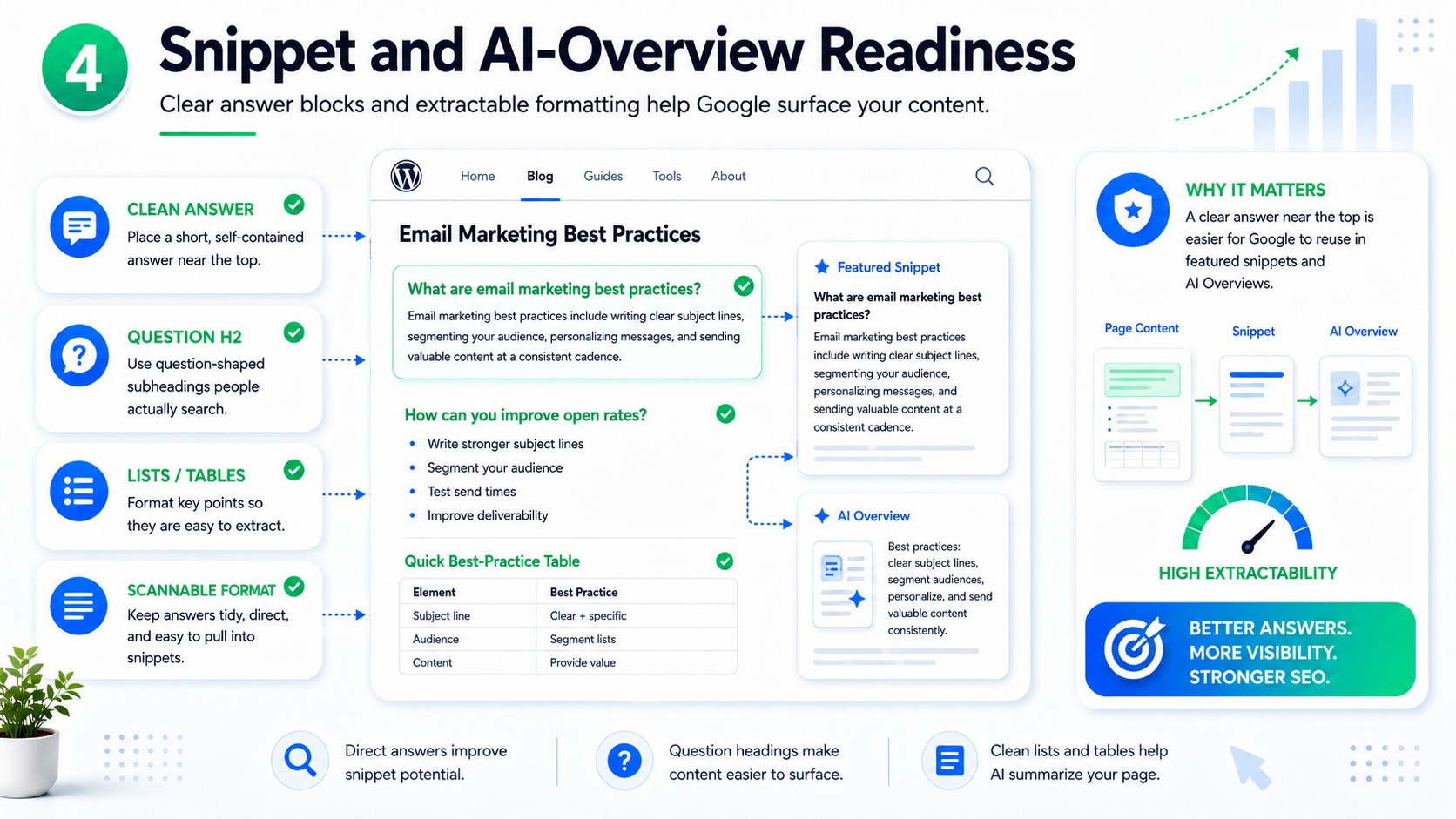
These are the highest-leverage points on the list, because most competitors still ignore them. A clean answer near the top is the unit Google lifts into featured snippets and AI Overviews.
- A clean, self-contained answer near the top for the page’s main question. That’s the exact unit Google extracts.
- Question-shaped subheadings where a question is genuinely what the reader is asking. Not every H2 needs to be a question, and a page where all of them are reads like it was built for a robot. Use them where they fit and leave the rest alone.
- Sections that stand on their own. If a section opens with “it”, “this” or “they”, it’s unquotable the moment an answer engine lifts it out of context. Say the thing.
- Tidy lists and tables that are easy to pull out.
5. Links and trust
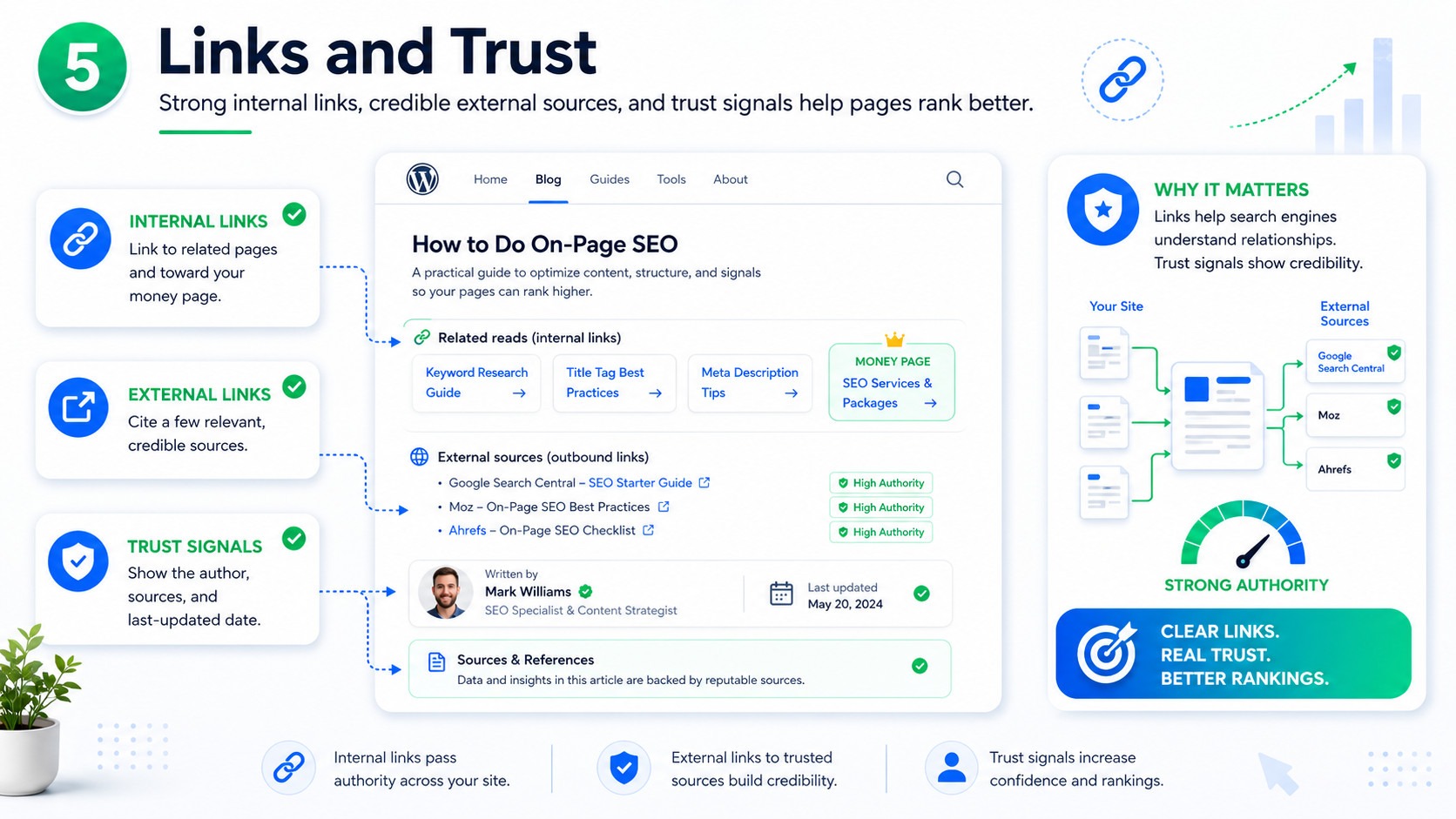
Internal links move authority around your site; external links and trust signals tell Google a real, credible person stands behind the page.
- Internal links to related pages and toward your money page (authority sculpting).
- A few relevant external links to credible sources.
- Trust signals: author, sources for claims, a last-updated date.
- Internal links revisited on a schedule. This is the one everybody means to do and nobody does. A post published in January has no links from anything you wrote after it, so it sits there getting weaker relative to the rest of the site. Once a month, go back and link the new posts to the old ones. It costs an hour and it’s the cheapest authority you’ll ever move.
6. Originality and assets
These six are what I added when 24 became 30, and they’re the ones that decide whether a page gets cited rather than just crawled. Anyone can tick the first five sections. Almost nobody does this one, which is exactly why it’s worth doing.
Your own take
Put something in the piece that could only have come from you: an opinion, a mistake you made, a number from your own business. This is the part AI can’t generate for you, and it’s the reason someone picks your page over the four others saying the same thing.
Real data and stats
Use real numbers, and link the source. Original data is the most-cited content on the web. If you don’t have your own, find credible figures and attribute them properly, the way I’ve done in the stats section below.
Verify the research
Get the stats from one AI, then hand them to a second one and ask it to check them. I do this on every post and it catches fabricated figures and dead studies every time. An invented statistic in a piece about being trustworthy is the worst own goal there is.
An embedded tool
A calculator, a quiz, an interactive checklist, something the reader uses instead of reads. It lifts time on page, and people come back to a tool in a way they never come back to a paragraph.
A linkable asset
Ask the blunt question: is there anything here worth linking to? Not “is this good”, but is there a specific thing on this page a stranger would cite? If the honest answer is no, the post won’t earn links however well it’s optimised.
A human voice
Read it aloud. If it sounds like every other post on the topic, it’ll be treated like every other post on the topic.
Want to see how a draft scores against all thirty before you publish? Run it through the checklist:
Prefer to audit a live page instead of a draft? Paste any URL into the free On-Page SEO Analyzer and it runs the same checks for you.
Run all of that before you publish. A post that passes on day one ranks faster than one you patch up weeks later. The point isn’t to hit all thirty every single time; it’s to never publish having skipped the ones that matter, sections four and six especially.
Where the work is (and what I automated)
Checking thirty things by eye, on every post, is exactly the kind of job people skip when they’re busy, which is most of the time. That’s not a discipline problem, it’s a tooling problem, and I got tired of losing to it.
✍️ My Take: The one people skip is section six, and it’s the only section that can’t be faked. Everyone will fix a meta description because it takes eight seconds. Almost nobody will stop and ask “is there a single original thing on this page”, because the honest answer is usually no and fixing it means actual work. But that’s precisely why it’s the section that moves the needle now. When AI can produce a technically perfect, entirely forgettable post in ninety seconds, the only defensible thing left is the part that came from you. My own biggest lift didn’t come from keyword placement. It came from adding a tool people actually used to a page that was already ranking, and watching how long they stayed.
The catch: running every one of these checks by hand on each post is tedious, so it doesn’t happen. I ended up building the thing I wanted: Intent SEO, a WordPress plugin that scores all of this live in your editor, grades your content by intent instead of exact-match keywords, tells you whether an answer engine can actually quote you, and then helps you fix what it finds. → See how Intent SEO scores your posts
Key statistics
- In a 2026 audit of over 10,000 sites, 47% were missing meta descriptions entirely. (RankNibbler – “The State of On‑Page SEO in 2026: We Analysed 10,000+ Websites”)
- In the same 2026 audit, 73% of websites had at least one critical on‑page SEO issue. (RankNibbler – “The State of On‑Page SEO in 2026: We Analysed 10,000+ Websites”)
- At the median, 60% of images on mobile pages included meaningful alt attributes in 2025, though up to 15% of images had blank alt values. (HTTP Archive – “SEO | 2025 | The Web Almanac”)
- Controlling meta descriptions in an SEO test produced an estimated 4.2% lift in monthly organic sessions. (SearchPilot – “Does removing meta descriptions improve click‑through rates?”)
- The median page scored 52 out of 100 for Information Gain (the amount of new meaning added beyond what already ranks) across 150 top‑3 pages sampled in June 2026. (On‑Page.ai Research – “Information Gain in Google’s Top‑Ranking Results: A Measurement of 150 Pages”)