
Keyword Research › Keyword Prioritization and Competitor Analysis
SEO keyword research
Learn how to compare competitor pages and keyword coverage to find distinct opportunities for your site. The key is to check which page ranks for each term and what that page actually answers.
A competitor's keyword list can look like a ready-made content plan, but each term only becomes useful after you check which page ranks for it and what that page actually answers.
That page-level check is the core of seo keyword research and competitor analysis. It shows you how a competitor covers a topic, and where your site has room to offer a distinct answer.
You’ll get 12 steps for turning competitor keyword data into a focused research process.
I’m Tony Hayes. I’ve been building marketing software since 2011, and today I build everything with AI, without writing code myself.
We’ll start by setting up the competitor research, then collect and organize keyword data. From there, we’ll find a distinct page opportunity and build a research process you can maintain.
The research process at a glance
| Stage | Purpose |
|---|---|
| Set up | Define the page and search competitors |
| Collect and organize | Find, group, and compare keyword data |
| Find an opportunity | Identify a distinct page or content gap |
| Build and maintain | Create a brief and recheck results |
Find this useful? Add us as a preferred source on Google and more of what we publish will show up in your results.
Set Up Your Competitor Keyword Research
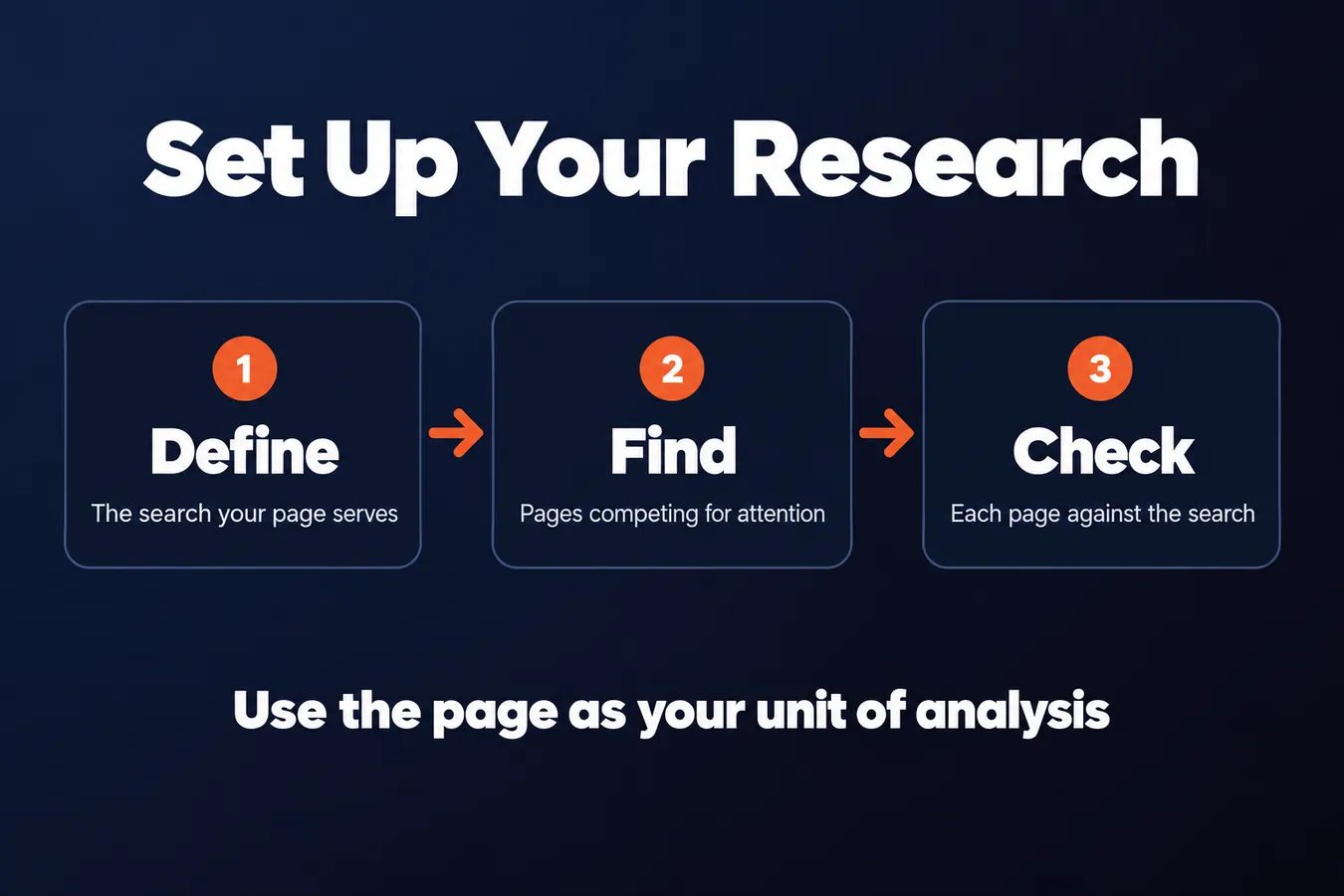
1. Define the search you want your page to serve
Start with the product, service, or topic your page will support. Then write down the searcher’s problem and the action your page should help them take.
A clear page purpose keeps your keyword research focused.
For this page, focus on comparing competitor pages and their keyword coverage to find opportunities for your own content. Use separate guidance to prioritize keywords and avoid keyword cannibalization.
2. Find the competitors that appear for your target searches
Search a small set of relevant queries and note which pages appear repeatedly. Include sites that answer the same need, even when they sell a different product or service.
Search competitors are the pages competing for the same attention.
Keep direct business competitors separate from search competitors. That distinction gives your competitor analysis a clearer view of the content and sites shaping search results for your target keywords.
3. Check each competitor page against the search itself
For each result, record the query, page URL, page type, and main task the page helps with. Check whether it’s a guide, product page, comparison, tool, or another format.
Use the page as your unit of analysis.
One domain can publish pages with very different purposes. Matching each page to the search helps you compare relevant content and keyword coverage, then spot gaps that fit your SEO strategy.
Collect and Organize Keyword Data
4. Find competitors' keywords with an SEO analysis tool
Enter a competitor domain into an SEO analysis tool. If the tool supports it, check individual page URLs too. Export the organic keyword data with the ranking URL, position, and any available search volume or difficulty metrics.
Treat the export as a lead list, then verify each keyword.
A competitor ranking for a term gives you a place to investigate. Check whether the query fits your audience and the purpose of your page before it goes into your content plan.
5. Use Google Keyword Planner to expand and check ideas
Add relevant seed terms to Google Keyword Planner, or enter a competitor landing page to find related keyword ideas. Review the suggestions one by one and keep the terms that fit your audience and the page you’re planning.
Use search estimates as one input in your analysis.
Keyword Planner data gives you estimates. Look at the search results too: the pages ranking there can show what kind of answer people are looking for and whether the suggested term fits your SEO strategy.
6. Group related terms by the page that can answer them
A keyword export gets messy fast. Group close variants and related queries when they point to the same need, then keep queries separate when they call for a different answer or format.
Build each group around the page that can answer it best.
For every group, record the leading keyword, supporting terms, search intent, and relevant competitor URLs. This gives you a clear view of the topic each page should cover and helps you keep separate page plans from competing for the same search.
7. Compare competitor keyword coverage page by page
Put query groups in rows and competitor URLs in columns. For each page, mark whether it answers the topic, mentions it briefly, or leaves it out.
The gaps are useful when they point to a distinct opportunity for your site.
Add notes about the examples, tools, explanations, and audience details on each page. Those details show where competitor content gives a complete answer and where your own page can serve the search more clearly.
Find a Distinct Page Opportunity
8. Compare what the pages actually deliver
Matching keywords can hide big differences in what a page gives the reader. Check the headings, format, level of detail, and questions answered across competitor pages.
Notice what each page offers: steps, comparisons, examples, templates, or a tool. Then record missing explanations and audience needs your site can credibly address.
The page itself is where the opportunity takes shape.
A keyword research tool can show you which terms competitors rank for. Your competitor analysis should also show whether their content gives searchers a useful answer.
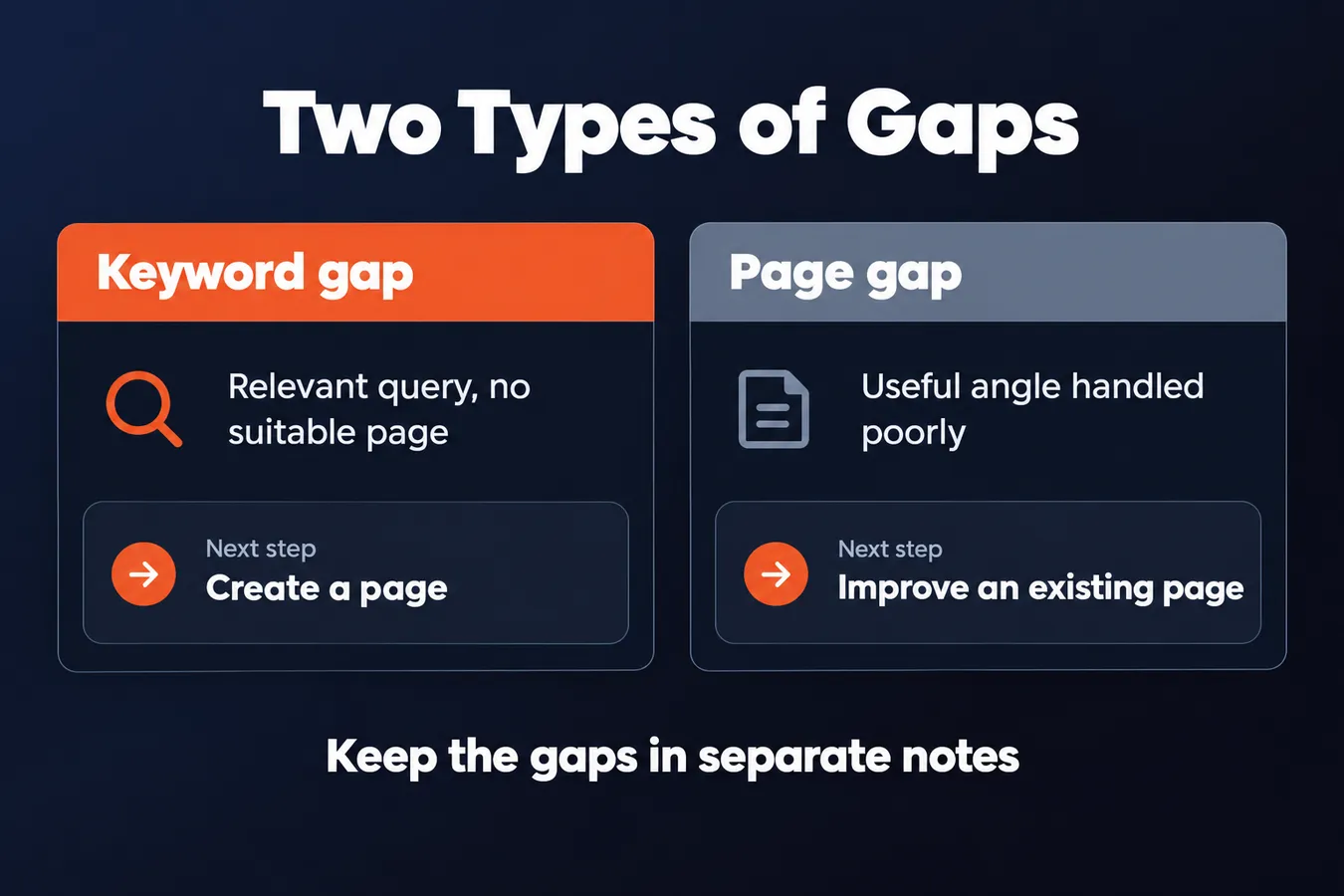
9. Separate keyword gaps from page gaps
A keyword gap is a relevant query a competitor page ranks for when your site has no suitable page. A page gap is a useful angle or answer that existing content handles poorly or leaves out.
Check both before you decide what to do. A missing query may call for a new page, while an existing page with thin coverage may be a better place to add the answer.
Keep the query gap and the content gap in separate notes.
That distinction gives you clearer insights from your SEO research and keeps your content strategy grounded in what searchers need.
10. Choose an angle your site can support
Match the opportunity to information, examples, or functionality your site can genuinely provide. State the page's purpose in 1 sentence, then explain how it will help the searcher.
Competitors can give you useful insights, but their structure is only one option. Choose a format that fits the query and your audience, whether that means steps, a comparison, examples, or a tool.
Build and Maintain the Research
11. Turn the comparison into a focused content brief
The competitor analysis should lead to a clear plan for one page. Write down the target query group, intended reader, page format, and the central question the content needs to answer.
Then capture the coverage required to answer that query and the distinct detail your page will contribute. For example, if the query group is about comparing keyword research tools, your brief might call for a comparison page that explains which features matter and adds your own criteria for choosing.
Keep the brief focused on this page. Keyword prioritization and checks for overlap with other pages belong in their own planning steps.
12. Recheck the search results when the page is ready
Search results can shift while you’re creating content. Before publishing, search your target query again and compare the current results with your research notes. Check whether the leading pages still use the same formats and answer the same kind of question.
Then confirm that your page has a clear purpose and fits the query group. Your final page should add a distinct contribution to the topic. If another page on your site already covers the same purpose, revisit your plan using your keyword cannibalization process.
Frequently asked questions
How do I find the right competitors for keyword research?
Search a small set of queries related to the page you’re planning. Note which pages appear repeatedly, including pages from sites that answer the same need even when they sell something different. Keep these search competitors separate from your direct business competitors.
How should I organize competitor keyword data?
Group related queries when they point to the same need and page. For each group, record the leading keyword, supporting terms, search intent, and relevant competitor URLs. Then compare the competitor pages against each group, noting whether each page answers the topic, mentions it briefly, or leaves it out.
What’s the difference between a keyword gap and a page gap?
A keyword gap is a relevant query a competitor page ranks for when your site has no suitable page. A page gap is a useful angle or answer that existing content handles poorly or leaves out. Keep the two in separate notes so you can decide whether to create a page or improve one you already have.
How do I choose an angle for a page based on competitor research?
Look at what competing pages deliver, including their format, explanations, examples, and audience details. Then choose an angle your site can support with information, examples, or functionality you can genuinely provide. Write the page’s purpose in 1 sentence and state how it will help the searcher.
My Take: I’ve been building marketing software since 2011, and that experience shapes how I look at keyword opportunities. So when I compare competitor pages, I want to know what the page actually helps someone do, and what my own site can credibly deliver. A keyword export gives me leads to check. The page itself shows whether there’s a useful opening: an explanation, example, format, or audience need that the competing content leaves out. I’d rather build a page around a clear answer my site can support than copy a competitor’s structure just because it ranks. That keeps the research tied to the work the page needs to do.
Aha Studio
Get the next playbook first
New playbooks and LaunchWatch reports land in Growth Signals, the free newsletter, along with the case studies and how-tos I find worth stealing.