New from Anthony Hayes: Aha Studio
Get found by the people searching for what you sell.
Local SEO and Google Business Visibility › Costs, Pricing and Choosing Help
Local SEO buying guide
A local SEO agency, a freelancer and doing it yourself can all get you into the Google Map Pack, but each one fails in a different way. This guide compares the three side by side and lists what to ask before you sign anything.
A local SEO agency, a freelancer and doing it yourself can all get you into the Google Map Pack. They fail in very different ways, though, and most businesses only find out which one they picked after several months of waiting.
If you searched for "local seo agencies near me", you're probably looking at a stack of agency websites that all sound the same. Most of them promise rankings. Few of them tell you what they'll actually do in the first 90 days.
Here's what you'll get from this post: a straight comparison of the three options, what each one really costs you, and the questions that separate a real local SEO contract from a bad one.
I'm Tony Hayes. I've been building marketing software since 2011, and today I build everything with AI, without writing code myself. That means I spend a lot of time around the tools and the people who sell local visibility, and I know which parts of the work are easy to fake.
We'll go through each option in turn: what an agency actually does for you, when a freelancer makes more sense, and what doing it yourself costs once you count your hours. After that come the contract questions and the red flags.
If you want the numbers, the separate post on how much local SEO costs goes into pricing, and the one on SEO pricing packages compares what different tiers include.
Three options at a glance
| Option | Best for | Main limit |
|---|---|---|
| Local SEO agency | Multiple locations or crowded metro markets | Account managers rotate |
| Freelancer | One business in one city needing hands-on work | Limited hours and backup |
| Doing it yourself | Single location with tight budget | Several hours a week |
Find this useful? Add us as a preferred source on Google and more of what we publish will show up in your results.
What a Local SEO Agency Actually Does for You
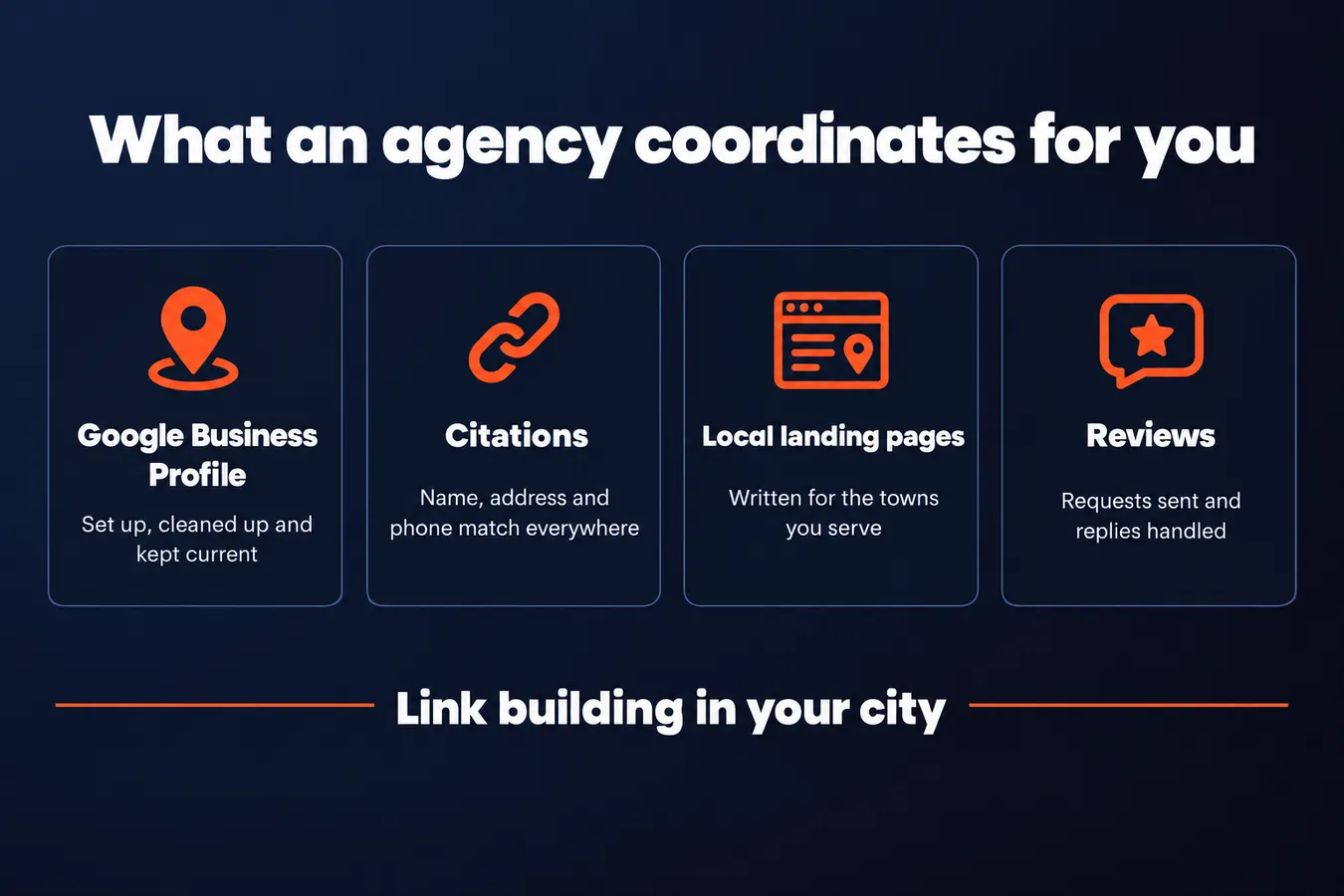
A local SEO agency is a team that works on the things that decide who shows up when someone searches for your type of business in your city. Most of the work falls into a handful of areas.
The first is your Google Business Profile. That's the listing with your hours, photos, services and map pin. An agency will set it up or clean it up, post updates, and keep the details matching everywhere else online.
Next comes citation cleanup. A citation is any mention of your name, address and phone number on other sites, like directories and local listings. If those details don't match, Google gets confused about where you are, so an agency hunts down the wrong or old ones and fixes them.
Then there are local landing pages. These are pages on your website aimed at a specific city or neighborhood, written so people searching for "plumber in [town]" have a reason to land on your site. Done well, they're written for real visitors and carry useful, specific detail about the places you serve.
Review requests are another piece. Agencies usually set up a system that asks happy customers for reviews at the right moment, and they help you respond to the ones you get.
Finally, link building in your city. That means getting local websites, newspapers, chambers of commerce and community groups to link to you. It's slow work, and it's where a lot of the real local authority comes from.
Where the real value sits is in the coordination. Any one of these tasks is doable on your own. What an agency gives you is someone who keeps all of them moving at once and knows which ones matter most for your market.
Agencies make the most sense when you have several locations or you're fighting for search results in a crowded metro market. Managing a dozen Google profiles, each with its own reviews and citations, is where a small in-house effort tends to fall apart. Competitive cities also punish guesswork, because the businesses ranking above you are usually already doing the basics well.
Now, the downside.
Account managers rotate. The person who sold you the contract may not be the person doing your work six months later, and the new person may need time to get up to speed on your business.
Your work is often shared, too. Agencies typically run the same playbook across many clients in the same industry and area, so ask how they keep your content and links from looking like everyone else's.
When a Freelancer Makes More Sense
A freelancer is often the right call for a single business in one city that needs steady, hands-on work. Overhead is low, so the rates tend to be lower too.
The bigger upside is who you talk to. With a freelancer, the person you hire is usually the person doing the work. You get direct access, you can ask a question and get an answer the same day, and you don't have to sit through an account manager relaying messages to someone you've never met.
That directness matters in local SEO. Changes to your Google Business Profile, new service pages, review requests and citation clean-up all go faster when there's one person making the calls.
Here's the catch, though. A solo freelancer has a ceiling.
There are only so many hours in a week. Once a freelancer is juggling ten or fifteen clients, something usually slips, whether that's response times, reporting, or the quality of the actual keyword and content work. Ask how many active clients they take on at once. If the answer sounds vague, that's a yellow flag.
Then ask what happens when they're sick, on holiday, or stuck in a family emergency. Most solo freelancers have no backup. Your rankings don't stop moving just because your SEO person is away, and a month of silence on a time-sensitive profile update can cost you calls.
A good freelancer will have a plan for this. It might be a trusted associate they can hand off to, a clear note on how long they're typically unreachable, or a process that keeps basic tasks moving while they're out. If they shrug and say "I'll get to it when I'm back," you know what you're getting.
I'd lean toward a freelancer for a small local business that wants a sharp, personal relationship and doesn't need a big team. Just go in with the capacity and backup questions answered first.
Doing Local SEO Yourself and What It Really Costs
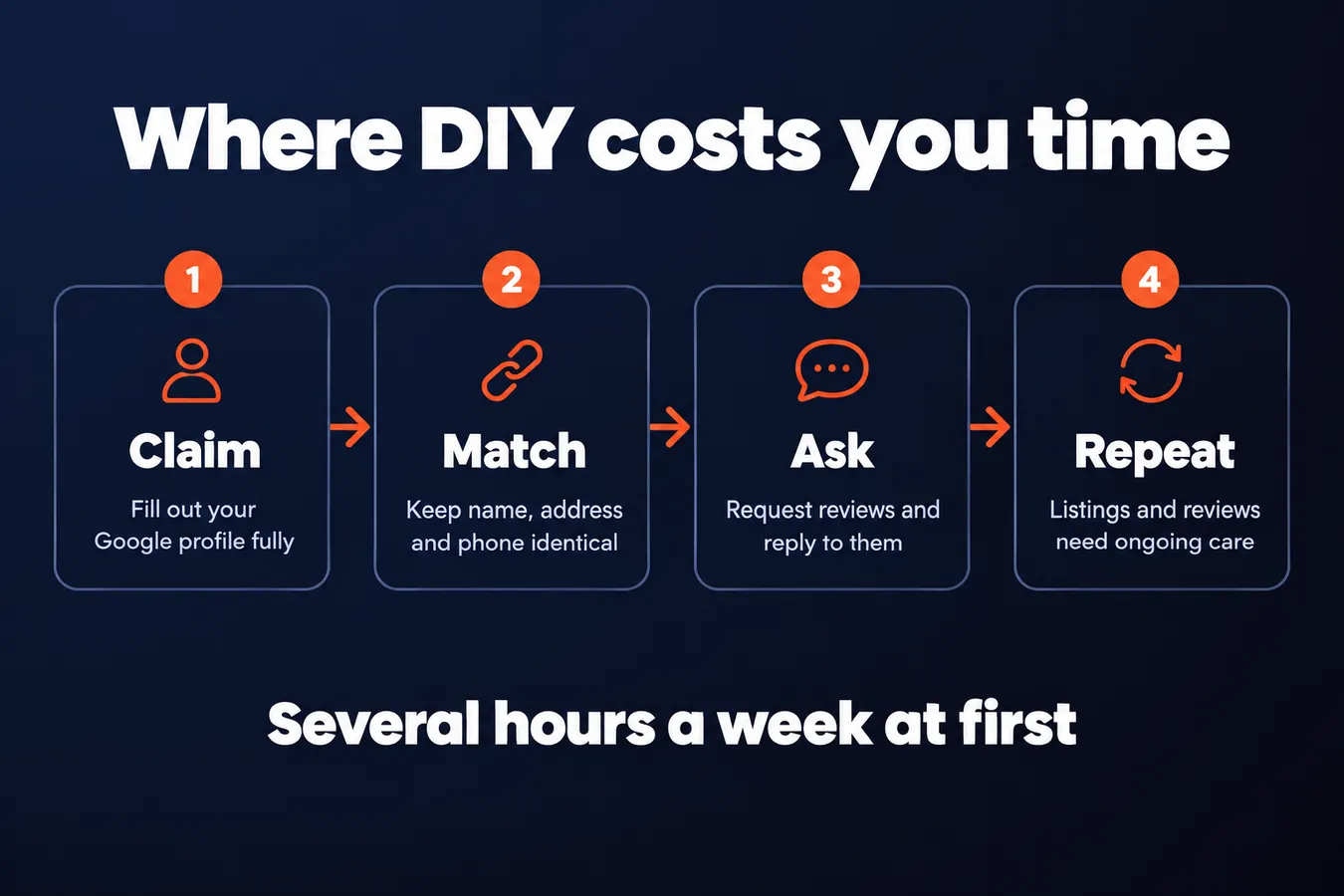
Doing it yourself is the cheapest option on paper. The real cost shows up in your calendar.
Most of the core work comes down to three jobs. First, you claim and fill out your Google Business Profile, including your categories, hours, services, photos and description. Second, you ask customers for reviews and reply to the ones you get. Third, you keep your name, address and phone number (NAP) identical across directories, because search engines use that information to decide whether your business is real and where it sits.
Here's the thing about time. In the first few months, a small business can easily spend several hours a week on this, mostly on cleanup and setup. Once the listings look right, the hours drop, but the work never fully stops. Reviews keep arriving, posts need updating, and directories change their formats without telling anyone.
The mistakes are where DIY gets expensive. Duplicate listings are the most common one. If you've moved, changed your phone number, or opened a second location, you can end up with two profiles fighting each other for the same searches. Changing your primary category without a clear reason is another. It can cost you rankings for the searches you already had, and it's hard to tell afterward which change did the damage.
Inconsistent NAP data is quieter but just as costly. An "Ave" on one site and "Avenue" on another, or an old phone number left on a forgotten directory, adds up to a lot of small confusion.
None of this is hard to learn. It's just a steady drip of small jobs, and most owners underestimate how many of them there are.
Questions to Ask Before You Sign Any Local SEO Contract
Before you hand over a credit card, ask these four questions. The answers tell you more than any pitch deck will.
Who is actually going to do the work?
Ask for the name of the person who will touch your account. Find out how many other clients they juggle at once. A shop with 40 local accounts and one overworked account manager is a different deal from a small team with a clear workload.
What do you own at the end?
This one matters more than most owners realize. You should own your Google Business Profile, with the login under your email and the agency added as a manager. You should own your website files and your hosting access, and you should get your reporting data and keyword lists when you leave. If any of that stays locked inside their account, you're renting your own online presence.
How do they report, and what do they measure?
Rankings are a fine thing to track, but they don't pay the bills. Push for reports built around calls, direction requests and map views, since those show whether real people are reaching out. I'd be wary of any report that leads with a long list of keyword positions and says nothing about customers.
What's the exit, and what does it cost?
Get the notice period in writing. A 30-day notice is common, but read the terms and don't assume. Ask about setup fees, and look hard at any long lock-in term, because a contract that's hard to leave is usually a sign of something the agency wants you to stop noticing.
Red Flags and How to Choose Between the Three
Start with the guarantees. If someone promises you a specific spot in Google's local results, walk away. No provider can control where Google ranks a business, and an honest one will tell you that before you ask.
What they can do is work on the things that tend to affect local rankings, like your Google Business Profile, your citations, your reviews and the pages on your website. That's real work, and it takes time. Anyone selling you a number-one spot in a set number of weeks is selling you something they can't deliver.
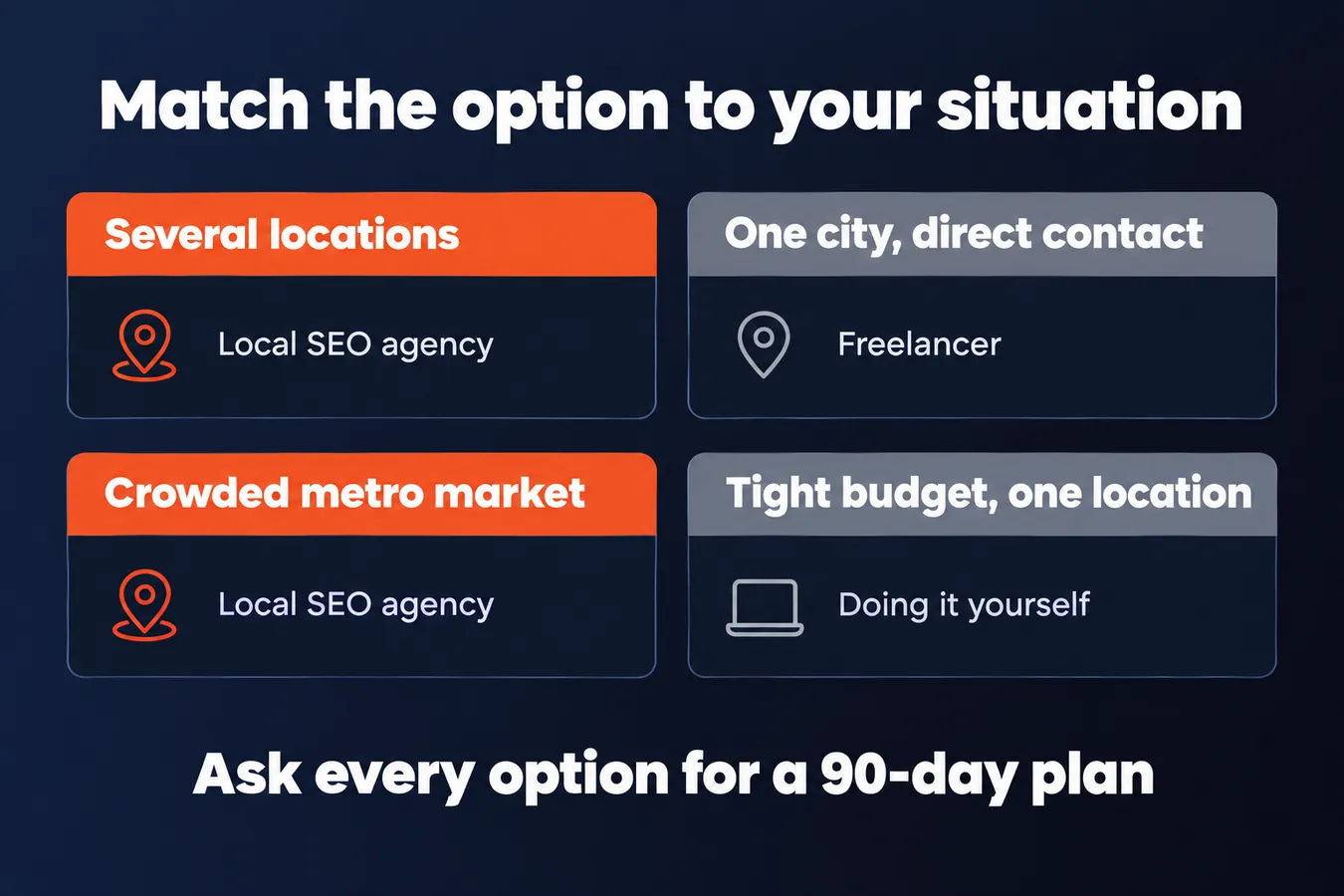
Match the option to your situation.
If your budget is tight and you've got one location, doing it yourself is realistic. You'll need to set aside a few hours a week, and you'll need to keep at it even when the results are slow to show.
If you run several locations, or you simply don't have the hours, an agency or a freelancer makes more sense. Agencies usually cost more and bring a team to the table. Freelancers are often cheaper and easier to talk to directly, but one person can only take on so much, so ask how many clients they're handling.
Here's a quick test. Ask each option for a short written plan for your next 90 days. Compare what comes back.
A good plan names the tasks, the order, and what they'll look at each month. A weak plan is vague: "optimize your profile," "build links," "create content." If one provider gives you a page of specifics and another gives you a few buzzwords, you've learned something useful.
Keep the plan in writing. If a provider won't put their 90 days on paper before you sign, that tells you how they'll handle the work after.
Who to pick by situation
| Situation | Option that fits |
|---|---|
| Several locations | Local SEO agency |
| Crowded metro market | Local SEO agency |
| One city, wants a direct relationship | Freelancer |
| Tight budget, one location | Doing it yourself |
Frequently asked questions
How do I pick an SEO company?
Start with the contract questions in this post. Ask who will actually do the work and how many other clients they juggle at once. Check that you own your Google Business Profile, with the agency added as a manager rather than the owner. Then ask for a written 90-day plan and compare what comes back. A vague plan with buzzwords tells you more than a polished pitch.
Can an agency guarantee me a spot in the Map Pack?
No, and if someone promises you a specific spot, walk away. No one controls where Google ranks a business. An honest provider works on the things that tend to affect local rankings, like your Google Business Profile, citations, reviews and location pages, and tells you that before you ask. Anyone selling a number-one spot in a set number of weeks is selling something they can't deliver.
Should I hire a freelancer or an agency?
For one business in one city that needs steady, hands-on work, a freelancer is often the better fit. You talk directly to the person doing the work. The catch is capacity and backup. Ask how many active clients they take on and what happens when they're sick or on holiday. If you run several locations or have a crowded metro market, an agency's team usually handles the load better.
My Take: The thing I see most often is a business that hires an agency, waits a few months, and only then realizes no one in the account actually owns the Google Business Profile. The login sits under the agency's email, and when the relationship ends the listing goes with it. So before anything else, I'd make sure your email is the owner and the agency is added as a manager. That one check protects you whichever option you pick, and it takes about five minutes. The rest of the work can be a fight worth having, but losing your own listing is the mistake I'd really want you to avoid.
Aha Studio
Get the next playbook first
New playbooks and LaunchWatch reports land in Growth Signals, the free newsletter, along with the case studies and how-tos I find worth stealing.
More in Costs, Pricing and Choosing Help
Explore the full Local SEO and Google Business Visibility hub