New from Anthony Hayes: Aha Studio
Get found by the people searching for what you sell.

Build in Public · #19
You do not have to be the expert, and you do not have to grind out original posts nobody asked for. You have to be the person who finds the best of what the experts are already saying, and frames it clearly. That is a system, and I demoed the whole thing live in a 45 minute session. The full session is below.
Find this useful? Add us as a preferred source on Google and more of what we publish will show up in your results.
The bottleneck was never the writing
Ask most people why they are not publishing authority content and they will say they do not have time to write. Watch them for a week and you find something else. The writing is not what stops them. Deciding what to write about is.
You sit down, you know you should post something worth reading, and the blank page asks a question you cannot answer quickly: out of everything happening in my niche, what is actually worth my time this week?
So the post does not happen. Not because writing is hard, but because choosing is.
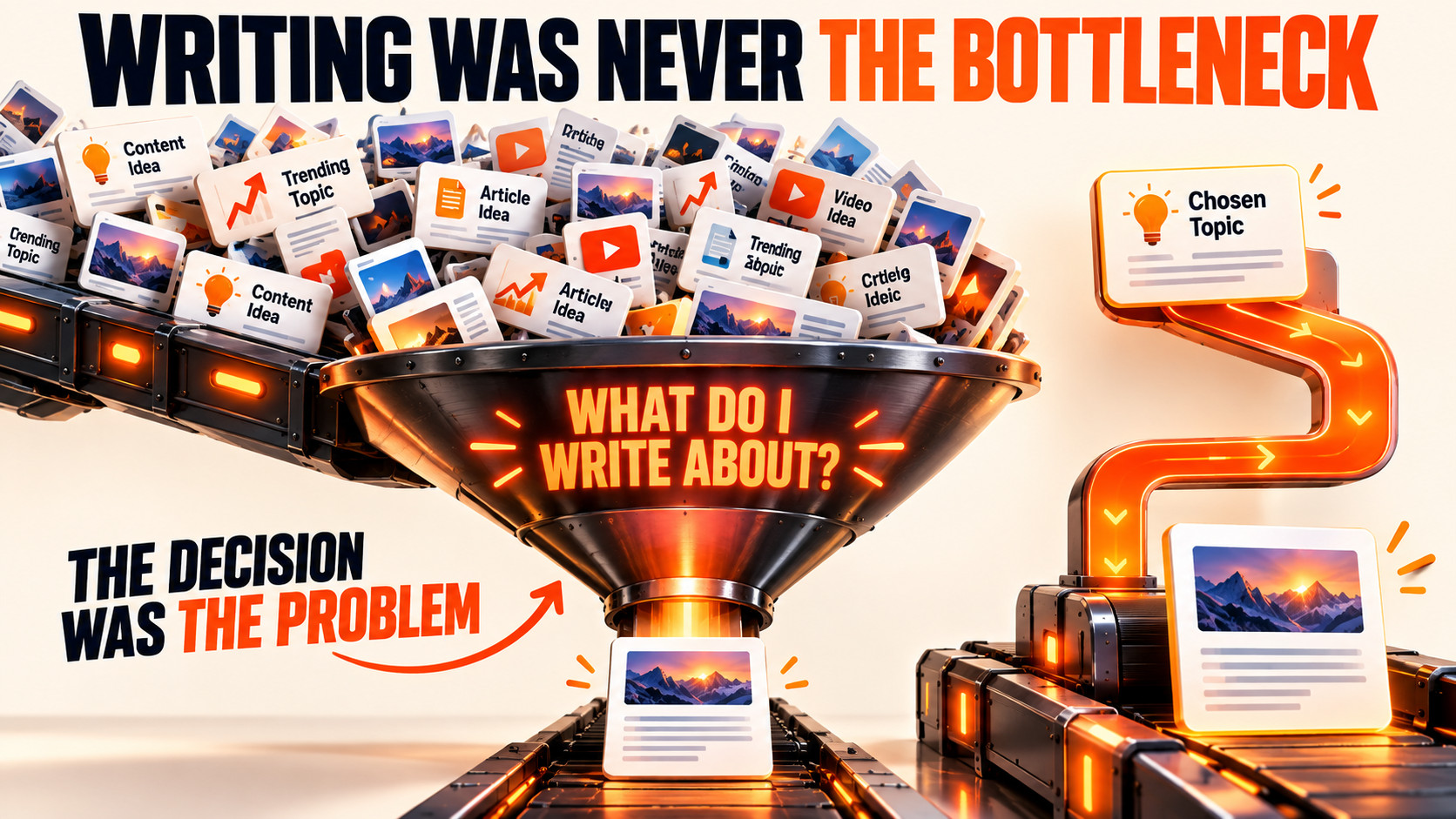
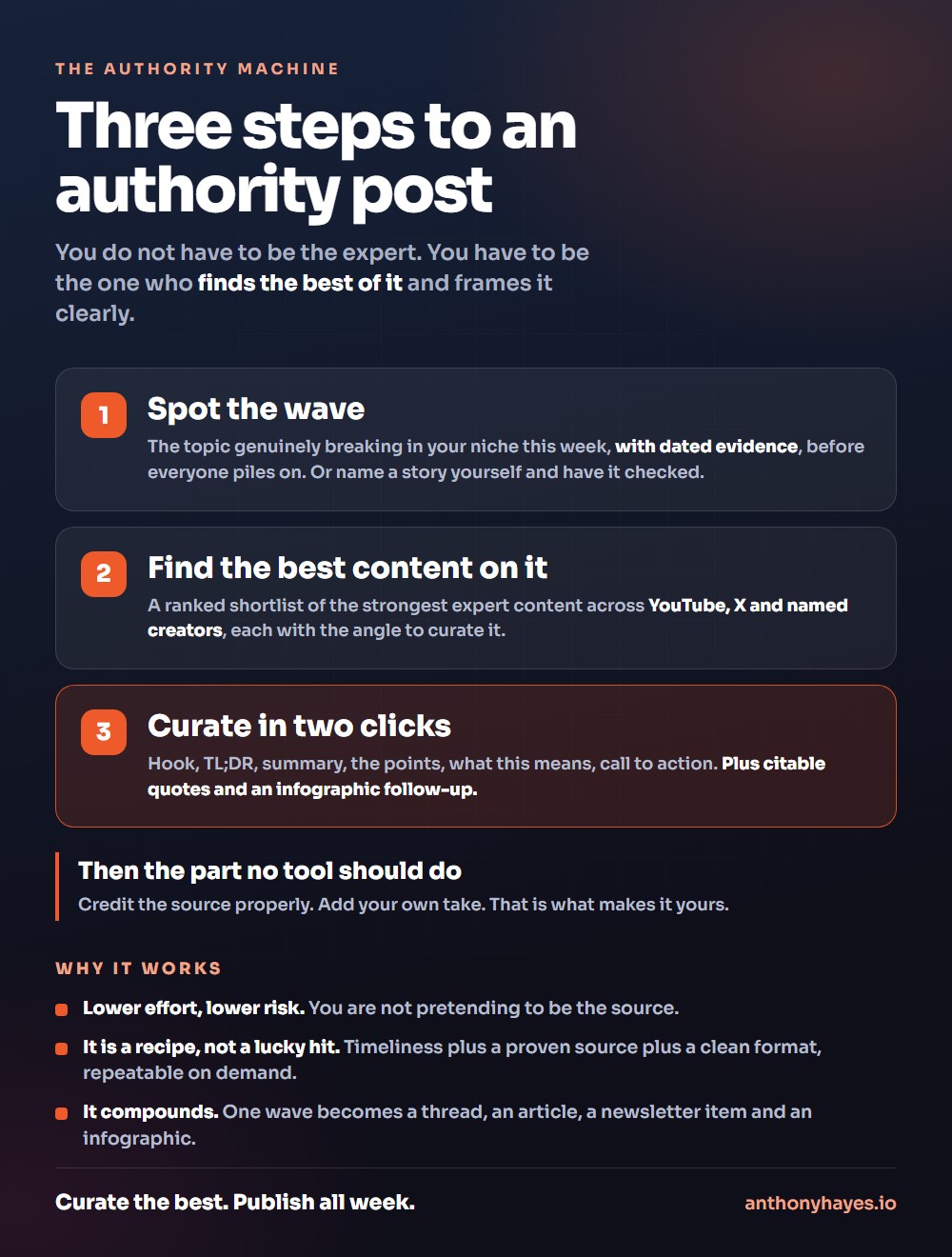
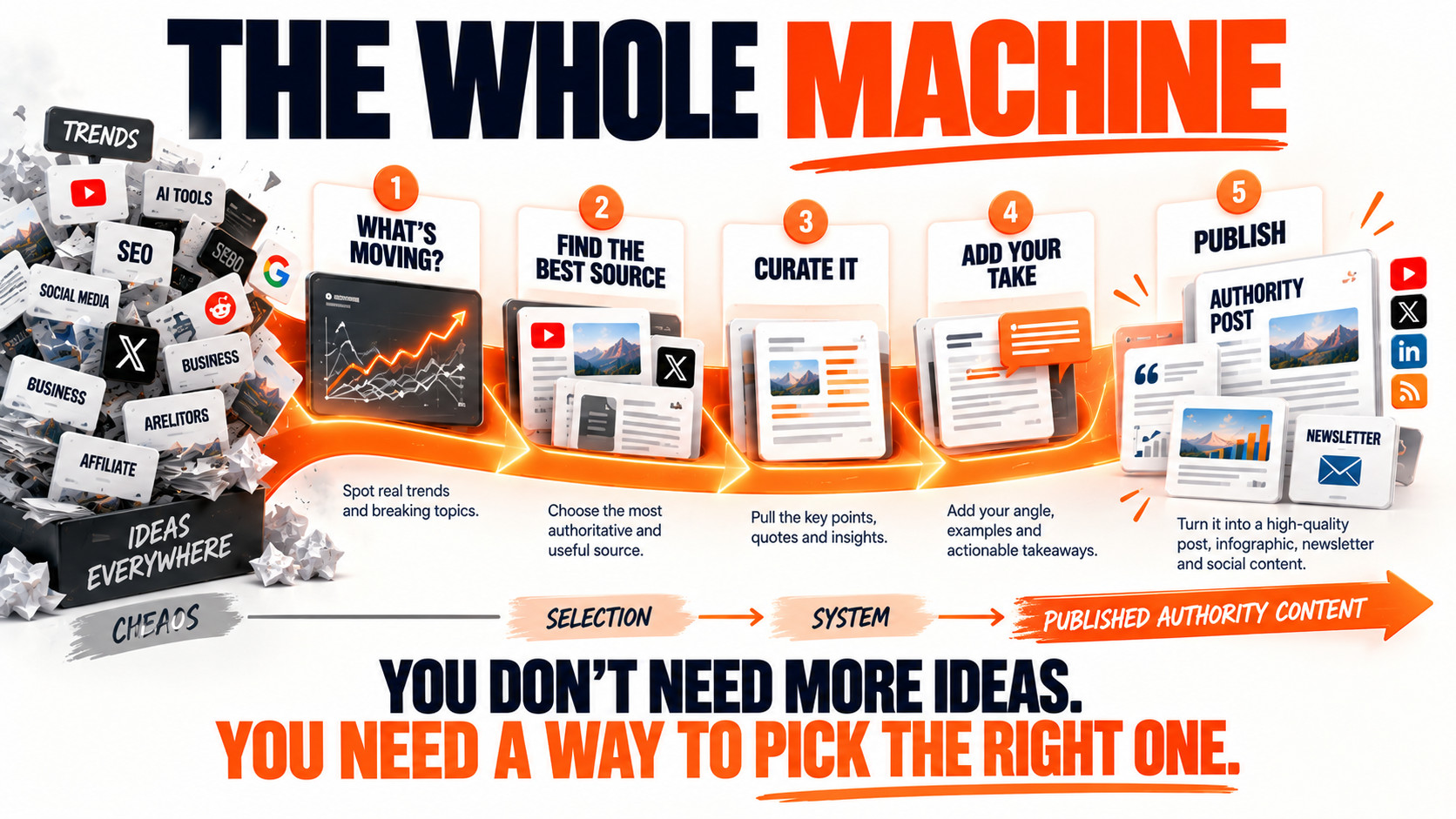
The Authority Machine is three steps that answer that question for you, then do most of the work once it is answered.
Step one: spot the wave
Find the topic that is genuinely breaking in your niche this week, with real dated evidence, before everyone piles onto it.
Timeliness is half the battle. A clean breakdown of the thing your niche is arguing about this week gets attention that exactly the same piece on an evergreen topic never will. Same effort, completely different result, purely because of when you published it.
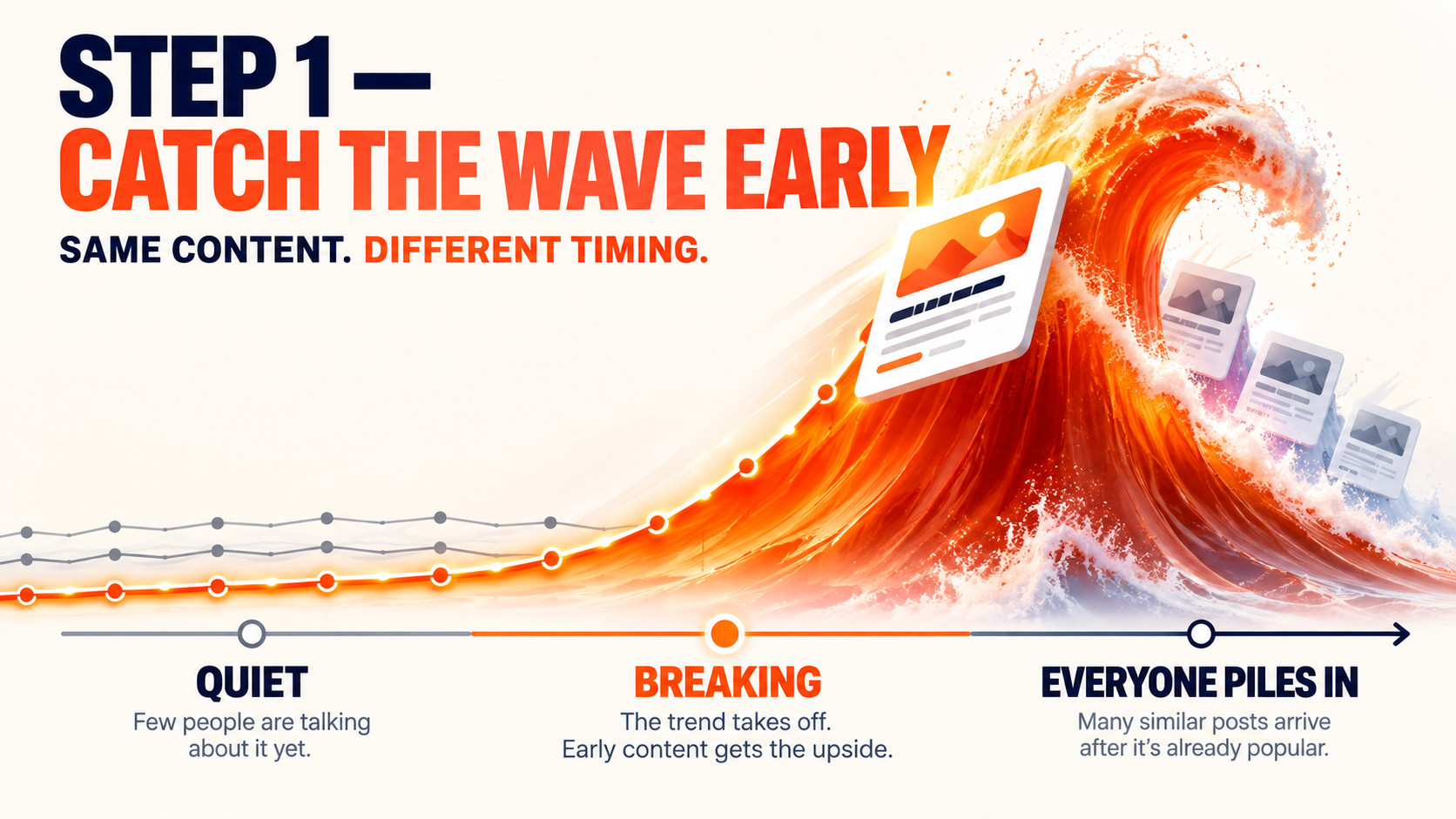
This is the Hottest Topics This Week prompt. You give it your niche and audience and it comes back with what is actually moving right now, with dates attached rather than a vague sense that something is trending.
That covers the case where you do not know what is moving. Sometimes you already do, and as of this week the tool handles that too.
There is now a Topics to watch box on the same card. You name the story you want to hit fast and it goes in as a priority seed. As I write this, Claude Opus 5.5 has been all over my feeds for two days. A scheduled research run has not necessarily caught up with something that new, but I can put it straight in and go.
The part I insisted on is what happens when a seeded topic is not really breaking. It still has to prove itself with real dated evidence. If it does, it comes back marked as one of mine. If it does not, it is listed under watching but not breaking yet, with what would have to happen first, rather than being dressed up as hot. Timeliness is the whole point of step one, so a fake wave is worse than no wave at all.

And if you are certain, you can skip step one entirely and type your topic straight into step two.
Step two: find the best content on it
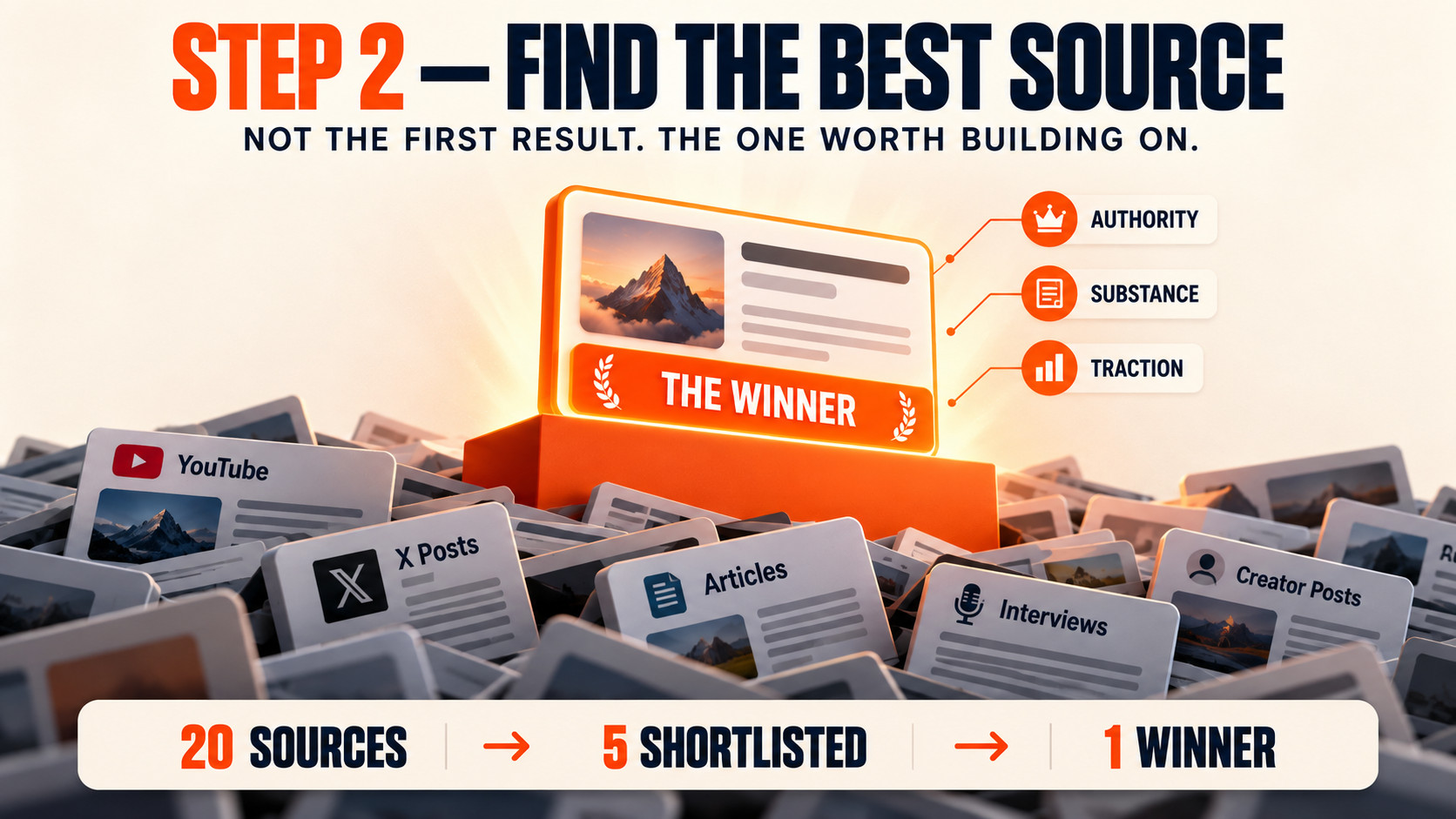
Once you have the topic, you need the strongest thing anyone has published about it. Not the first result, the best one.
The Find Authority Content prompt gives you a ranked shortlist across YouTube, X and named creators, and for each one an angle you could take to curate it. You are standing on material that already proved itself with an audience, instead of guessing what might land.
That is the part almost everyone skips, and it is the part that decides whether the post is any good.
Step three: curate in two clicks
Feed the winner into Content Genesis and it turns it into a finished authority post in the Authority Breakdown format: hook, TL;DR, summary, the points, what this means, and a call to action. You also get citable quotes, and an infographic follow-up to post after it.

Then you do the part no tool should do for you. You credit the source properly, and you add your own take. That is what makes it yours rather than a summary anyone could have produced.
Tube Genesis, the video-first twin, comes with it and does the same job for video sources.
Why it works
Three reasons, and they stack.
Curation is lower effort and lower risk than original content, and it still builds authority. You are not pretending to be the source. You are the person who found the best of the topic and made it easy to understand. Readers value that, and they remember who did it.
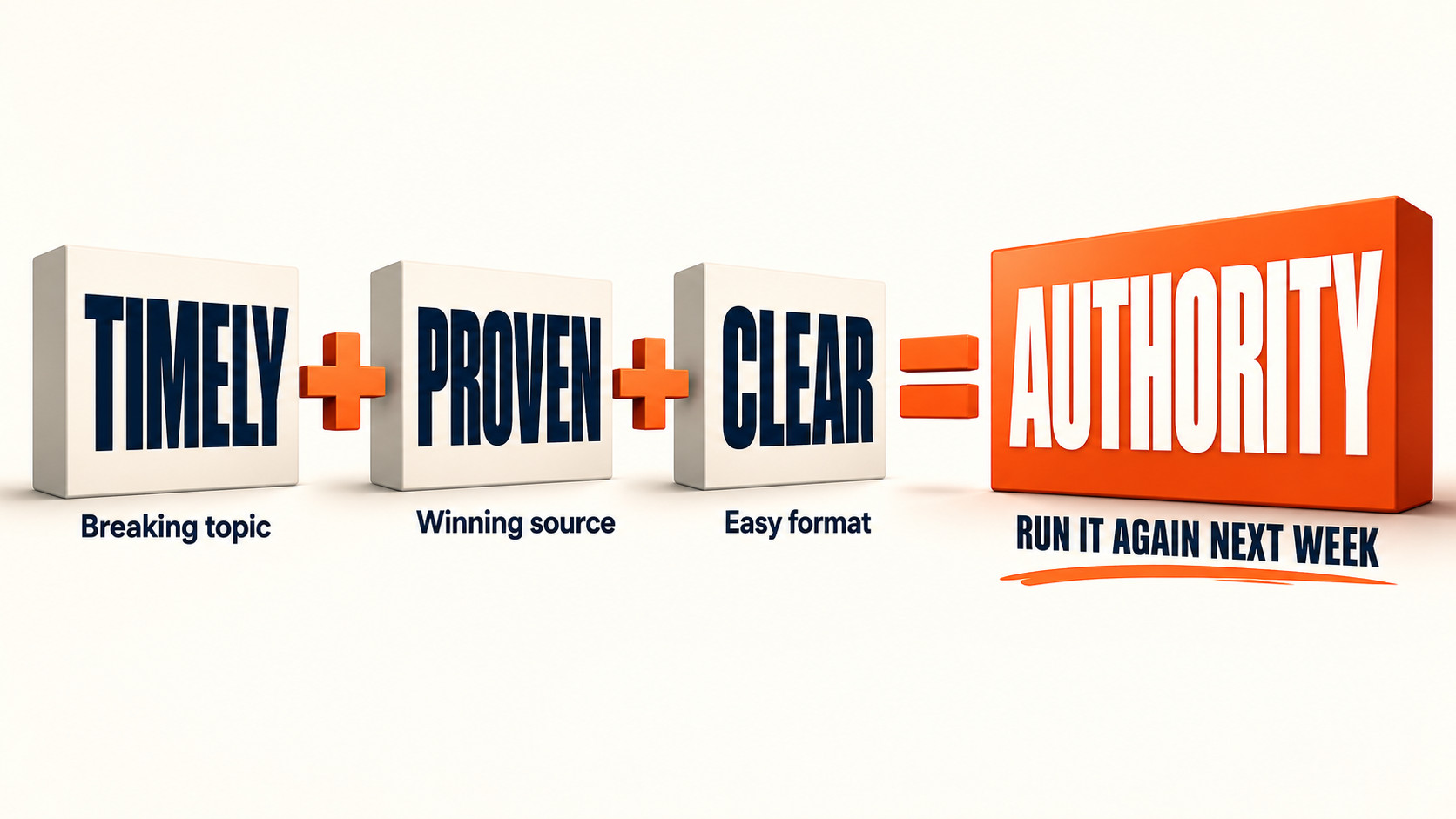
Timeliness plus a proven source plus a clean format is a recipe, not a lucky hit. Each part is repeatable on demand. That is the difference between a post that did well once and a thing you can run again next week.
It compounds. One wave becomes a thread, an article, a newsletter item and an infographic. To anyone following your niche that week, you are everywhere on the topic, from one piece of research.
To show what the format can do: one creator, Mario Joos, ran this exact shape last week while the YouTube algorithm shift was still breaking. He curated a YouTube creators video into a list of 50 key takeaways and got in early, which is the whole play. On the day we checked, that post was past roughly 66,000 views and the infographic follow-up was climbing past roughly 8,500. Those are his real public numbers, and they illustrate what the format is capable of. They are not a promise of what you or I will get.
What a week actually looks like
The old way is one hard original post, whenever you find the time, usually less often than you meant to.
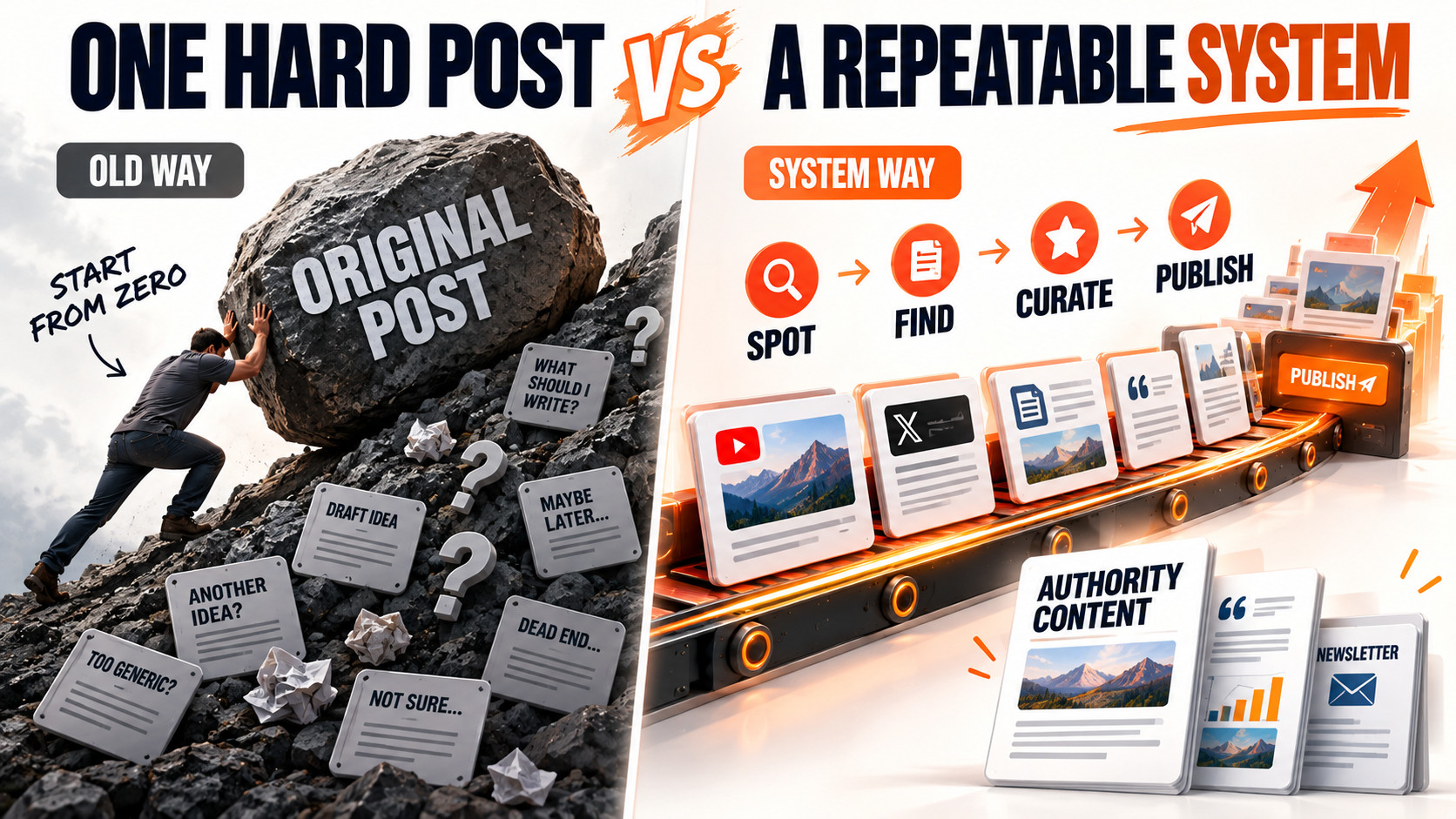
The system way is a rhythm. Run step one, or let it run on a morning schedule so the waves come to you. Pick the topic that fits your audience. Run step two. Curate in two clicks. Add your take and publish. Then do it again when the next wave shows up, which in most niches is more than once a week. In anything touching AI it is several times a week, because the releases and the reactions to them have not slowed down at all.
Last week gave us two inside the same seven days: Jev, the new release from Typesafe, and the YouTube algorithm shift. Within a day or two my feed was full of people working out how to use Jev and posting what they found. That is exactly the window a curated breakdown lands in, and it is the window that closes while you are still deciding what to write.
That is how one person produces a steady stream of authority content without a content team behind them.
The last piece: the prompts are inside the tool now
Here is the bit I am most pleased with, and it is the thing that turns this from a method into a machine.
Those two research prompts used to live in a document. You copied them, pasted them, edited your details in, and hoped you had not broken anything. That is a small amount of friction, and small friction is what quietly kills systems.
They are now built into Content Genesis itself. One card, a few boxes: your niche, your audience, your topic. It fills the finished prompt and opens it in ChatGPT, Claude or Gemini with your details already in place and web search on. You run it there, then feed the winners straight back into Content Genesis.
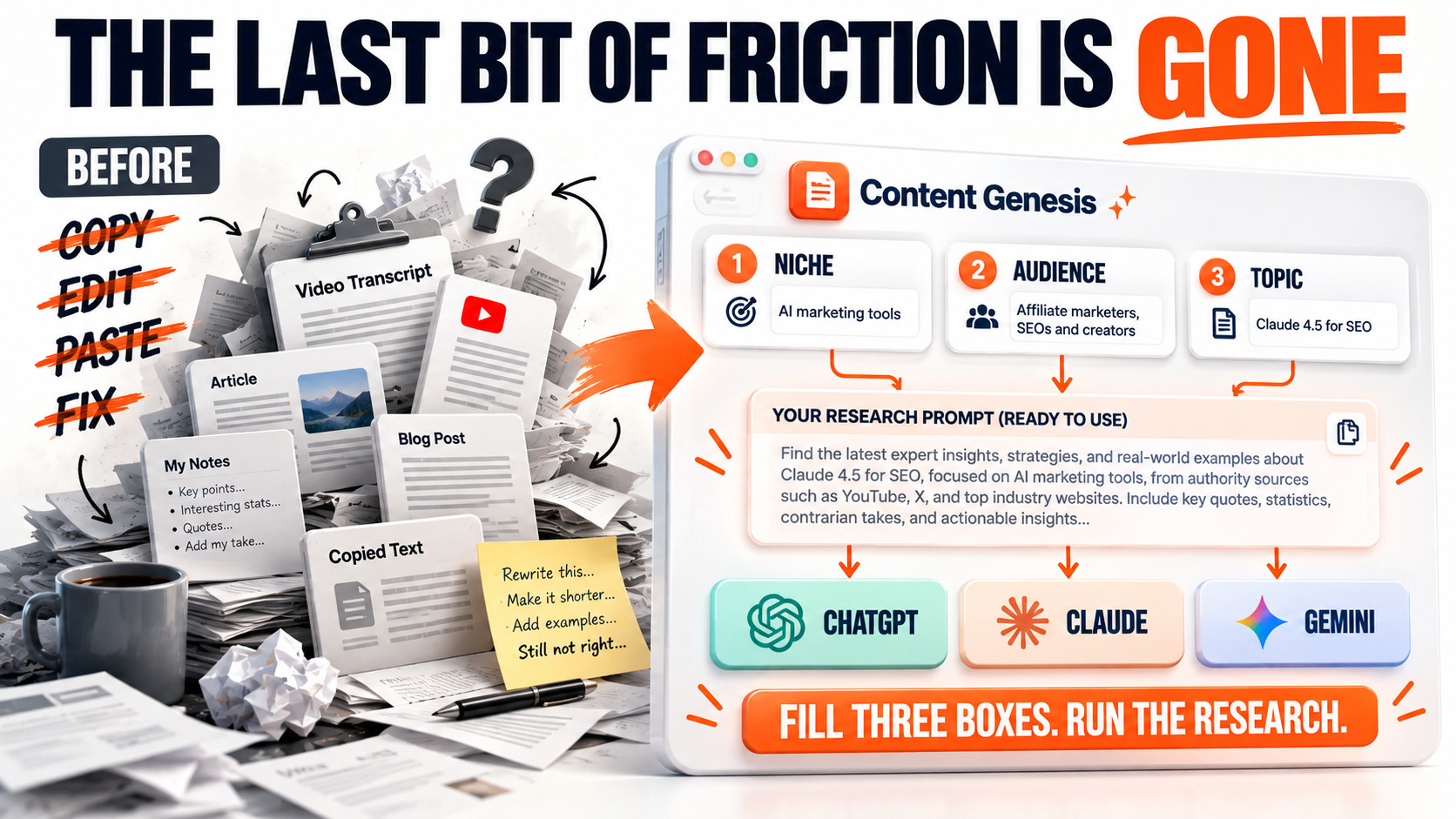
The tool does not pretend to do the searching itself. It fills the prompt properly and hands it to the AI that is good at searching. That honesty is deliberate, and it is why the loop actually holds together.
I built it for the live session and shipped it the same week. That is the whole reason for doing these sessions live. It forces the thing you have been meaning to build to actually exist by Wednesday.
The tool is available now, and the bonuses that went out with the launch stay with it. If you are reading this months from now, you get the same system and the same extras as the people who watched it live.
My Take: For a long time the honest answer to “why are you not posting more” was that I did not know what to post. Not a confidence problem, a decision problem. Every week has too many possible topics and no obvious way to rank them. What changed is that the deciding got solved separately from the writing, and once the deciding was solved the writing stopped being the hard part. That is also why I put the two prompts inside the tool instead of handing people another document. A system you have to assemble yourself is a system most people never run twice. The bottleneck is gone, the missing piece is built in, and anyone can run the same loop on the day they get it. I would rather ship that than another feature nobody asked for.
Content Genesis
Run the same loop this week
Content Genesis turns the best content on this week’s topic into a clean authority post, with the two research prompts built in. Tube Genesis, the video-first twin, is included.